Baked salmon fillet is one of those recipes that can go south for all the wrong reasons… You might wonder what I mean by this.
You see, it’s virtually impossible to undercook a good-quality, fresh salmon fillet. Salmon is often eaten raw anyway (e.g., in sushi). However, overcooking your salmon fillet makes it unpleasantly dry and flavorless. In fact, it is the biggest mistake you can make when preparing a salmon fillet, whether you bake it or use another cooking method.
So, the real question isn’t “How long should you bake a salmon fillet?” but “How long can we cook it before it dries out?”.
Pre-Sear Salmon Fillets or Not?
A big question is whether you should pre-sear your salmon fillets in a pan before baking. It will definitely give you very different results.
My answer to this question is simple: I do pre-sear my salmon fillets before baking, and this recipe will show you how to do just that.
Searing your salmon fillet before baking gives it much more flavor, and I can’t think of any drawbacks to this method. If you use an oven-safe pan for searing, you don’t even have to wash more dishes.
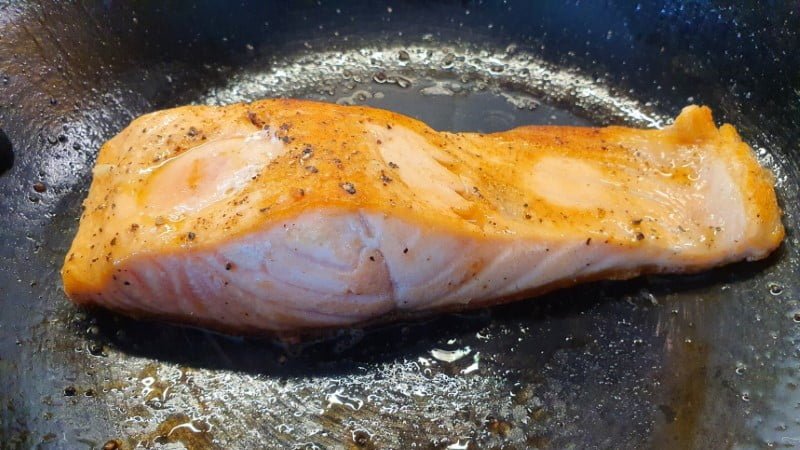
How to Bake Salmon Fillet
Baking salmon as a fillet is arguably the best and most popular way to enjoy this beautiful fish. Here are a few tips to help you prepare a perfect salmon fillet in the oven.
- Preheat the oven before you even get to the fish. Preheat it to 350 F (180 C), no convection or fan.
- Use an oven-safe pan or a separate baking tray. I prefer to use a cast iron pan, but you can use any type that’s suitable for the oven (with a metal handle). If you don’t have such a pan, simply transfer your fish after searing to a baking sheet and then into the oven.
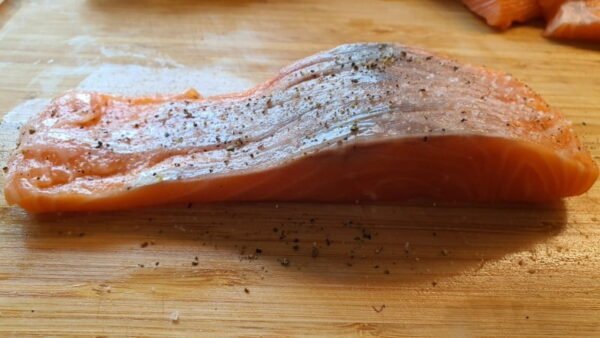
- Clean the salmon. It’s up to you whether you leave the skin on. Some prefer it with the skin, but I usually remove it. Even the highest-quality salmon may contain some bones here and there. To ensure there aren’t any, slide your hand across the thickest part of the salmon fillet. If you feel a bone poking through, remove it with your hand or use a pair of tweezers.
- Season the salmon fillet. Every fish loves good seasoning; salmon is no exception. It is such an exceptionally high-quality and tasty fish that it will be delicious with only salt. So I leave it up to you whether you season it or not. I like to add salt, freshly ground pepper, nutmeg, one thickly sliced clove of garlic per fillet, and fresh thyme. Or at least some of these. But again, it will taste incredibly delicious if you just add salt to it.
- Heat up the pan over high heat first, do not add fat at this point. When it’s hot enough, turn the heat down to medium-low.
- Coat both sides of the fish thinly with oil. You only need a couple of drops of oil per salmon fillet. This way, by putting the fat on the fish instead of pouring it into the pan, the added fat won’t burn.
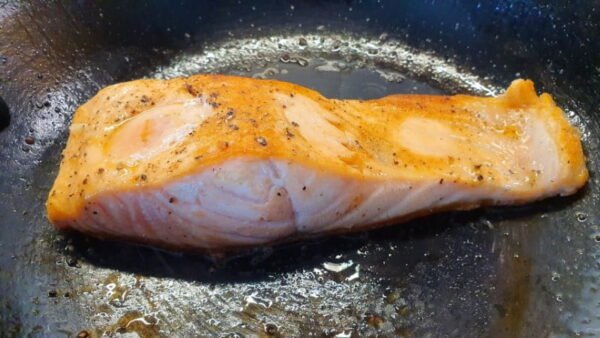
- Place the salmon fillets in the hot pan skin side down and cook for 2 minutes on one side. Do not touch or move it—salmon is a very delicate fish, and it can fall apart and stick very easily. If your pan was hot enough, you coated the fish with oil, and you don’t move it, after 2 minutes it won’t stick to the pan and you will be able to turn it easily.
- Turn the fish after two minutes with a thin spatula. Move your spatula gently under the fish, let it separate from the pan, and then turn it. If you use a cast iron skillet, it’s best to use a thin metal spatula for this. But for a nonstick coating, just use a regular thin spatula.
- Cook for another two minutes. Again, don’t touch it while it’s cooking. If you’ve added garlic, discard it before putting your pan into the oven so that it won’t burn later.
- Place the pan in the oven. Be sure to handle your pan with oven mitts, as oven-proof pans’ metal handles tend to heat up and can burn you. If you don’t have an oven-safe pan, transfer your fish into a baking tray with a spatula and follow the instructions.
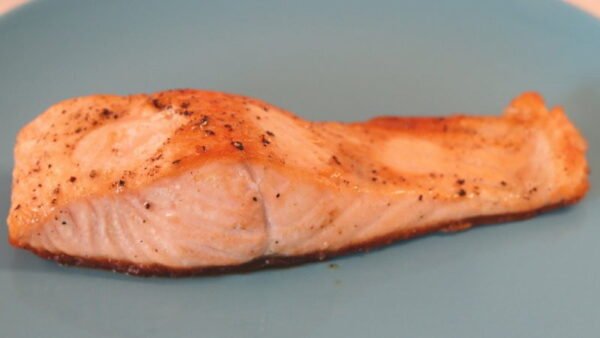
- Bake the salmon fillets in the oven until you reach your preferred doneness. Baking time depends on how you want your salmon to be cooked. I usually bake it for 4-5 minutes; at this stage, the fish is only slightly undercooked at the thickest part. This results in an extremely juicy, flaky, and tender salmon fillet. No worries about it being raw: it will be completely cooked after you take it out of the oven and let it rest. Bake for 10 minutes if you want the fish to be cooked all the way through. I definitely do not recommend leaving it in for any longer than this. Please note that the exact cooking time may depend on the thickness of your salmon fillet and also your oven.
- Let it rest for 4-5 minutes. Just like a steak, salmon fillets continue cooking after you take them out of the oven. If you let it rest, this will result in evenly distributed heat and moisture throughout the fish.
- Serve it with lemon. It’s up to you what side dish you serve your salmon fillets with, but don’t forget the lemon. Salmon just loves lemon juice, and I leave it up to your guests whether they eat it with just a few drops or with the juice of half a lemon.
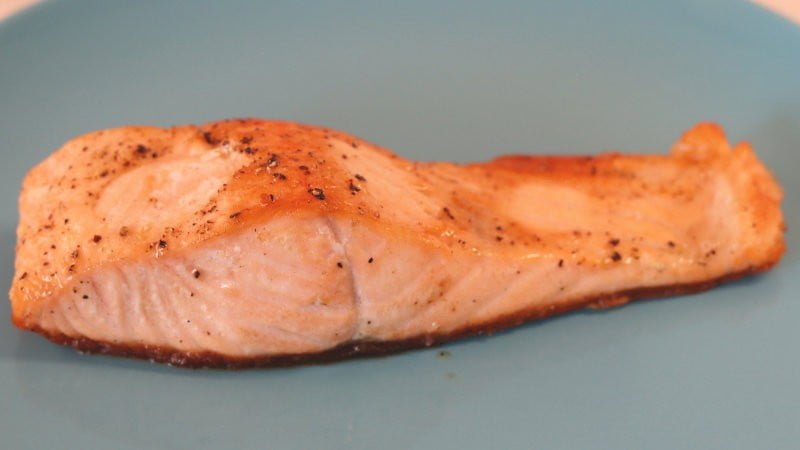
Seasoning Baked Salmon Fillets
Salmon has a pretty distinct flavor, so it doesn’t necessarily need a lot of seasoning. But as with all types of food, adding the right spices can nicely complement and also elevate the aromas.
Salt is one thing you shouldn’t skip. I know it is a question of taste, so use as much as you like, but salmon, just like every fish, needs salt.
A simple approach is to add freshly ground black pepper, and you’re good to go.
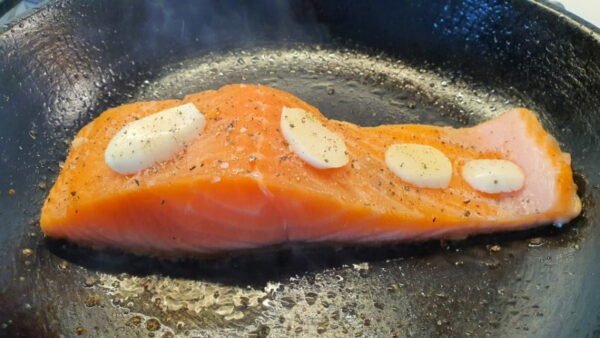
I always add one thickly sliced garlic clove per fillet; there are only a few things better than fish and garlic. Slice your peeled garlic cloves and place them on top of the fish when you put it into the pan. Once you turn the fish, the garlic will get to the bottom and fry. Before putting the salmon into the oven, discard the garlic slices so that they don’t burn. Another option would be just to add the crushed garlic clove to the pan and baste the fish while it’s in the pan.
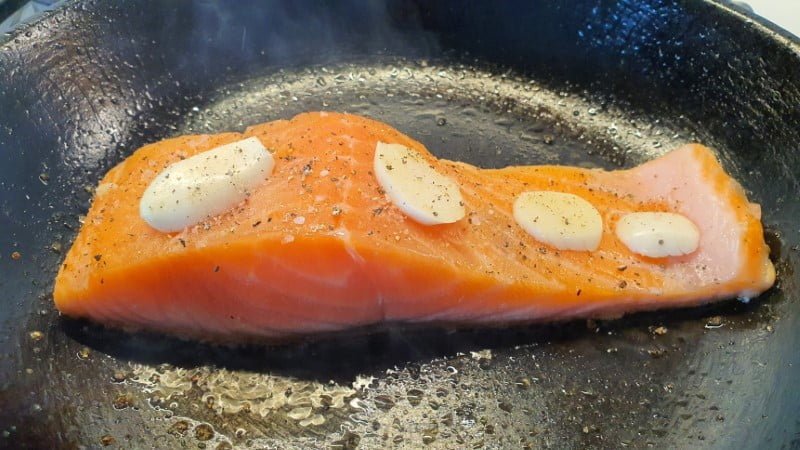
Other than these, you have quite a few options to season your baked salmon fillet. Thyme and rosemary are both a good pairing, better if you have fresh sprigs, but you can also use dried herbs. Salmon is also good with just a hint of freshly grated nutmeg.
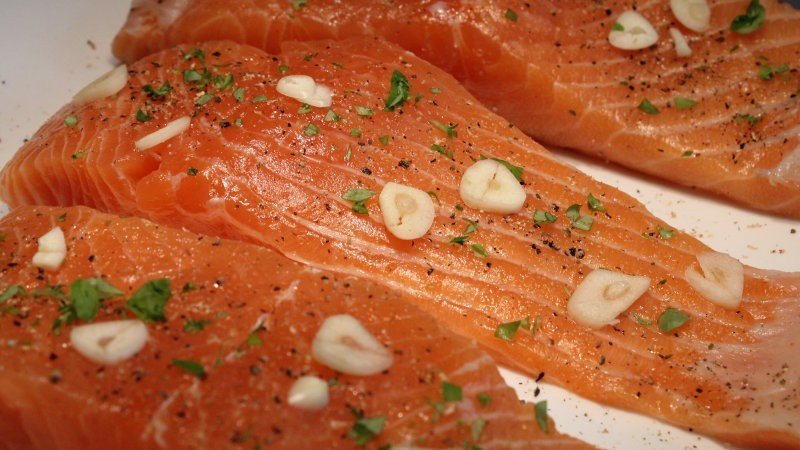
And yes, don’t forget the lemon. This is not a conventional seasoning, as you don’t add it while preparing the fish, but when serving it.
What Type of Fat Should You Use?
To cook your salmon fillet perfectly and prevent it from sticking, you should use some type of fat or oil. You really just need a few drops to smear on the fish, but you can’t skip that small amount.
I would say you should use the type of fat that’s most suited for your diet or your preferences. The only important thing to pay attention to is that you use a high smoke point oil.
Neutral vegetable oils (canola, sunflower, vegetable oil, etc.) can be a good starting point. Avocado oil is very trendy these days; you can use that too.
But you can also use a very good-quality extra virgin olive oil. Contrary to popular belief, if it’s good quality, then the smoke point is high, so it is safe to use in the oven or in the pan when searing your salmon.
Serving Baked Salmon Fillets
Baked salmon fillet is an incredibly delicious dish. When prepared well, the flavors and aromas are like no other, the fish perfectly melting in your mouth. I figure even people who usually don’t like fish tend to enjoy salmon fillet.
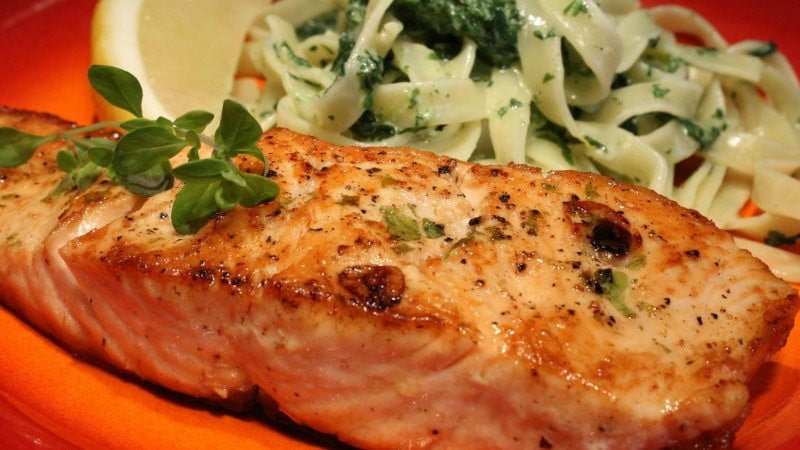
It is very low in calories but high in omega-3 fatty acids, so I wouldn’t choose a heavy side dish to go with it. Some light salad, steamed vegetables, or a vegetable pasta (like spinach tagliatelle, as you can see in this picture below) are perfect with a baked salmon fillet.
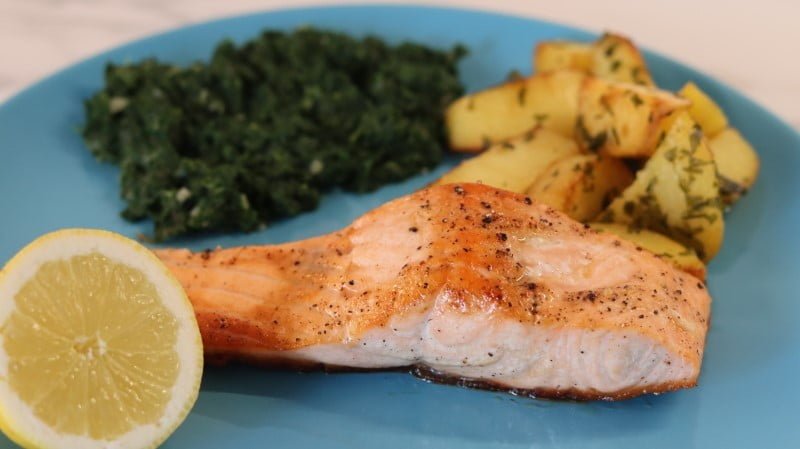
In the next picture, I served it with baked parsley potatoes and garlic spinach. But it also goes extremely well with a vegan Greek salad (no Feta cheese), the latter being a low-carb dish.
One thing is important though. As I mentioned before, it’s up to your guests’ tastes what you serve your baked salmon fillets with, but never forget the lemon!
How Big Is a Salmon Fillet?
If you buy your fillets pre-cut, you don’t need to worry about the size. Just bake the portions according to the recipe.
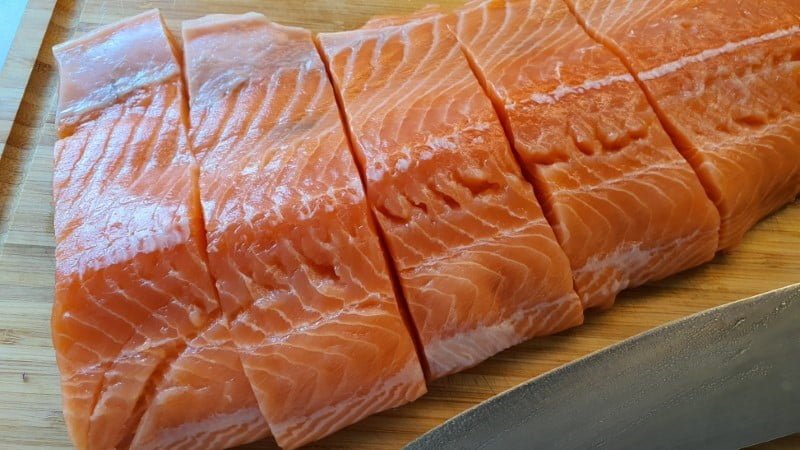
But sometimes you can only get a whole or half a salmon, and you need to cut it into individual portions. This is an even better option, as you can use the tail end in other recipes.
One typical serving (slice) of salmon fillet is usually about 7 ounces or 200 grams, just under half a pound. That’s 2 to 2 1/2 inches or 5-6 cm.
If you cook for people who eat smaller portions, 1/3 pound is a good measure for a smaller serving of salmon. That’s about 150 grams or 5.3 oz, and around 4-4.5 cm. For more detailed information on how much a salmon fillet weighs just click on the link.
If You Like Your Salmon Fillets Crispy
To each their own—I am definitely not one to judge anyone’s culinary preferences. I’m also aware that many people do like overcooked fish—or, more precisely, they hate fish when it’s even slightly undercooked.
This method that I’m describing will leave your salmon fillets slightly crispy, thanks to searing them for 2+2 minutes before baking.
If you don’t like crispy salmon though, simply sear them for 1 minute 30 seconds on each side over low heat before baking.
On the other hand, if you like your salmon fillets really crispy, sear them for 2 and a half or even 3 minutes on each side before putting them into the oven. In this case, use the same medium-low setting that I recommend in the recipe.
Baked Salmon Fillet
Equipment
- Oven-safe pan
- Thin spatula
Ingredients
- 1 salmon fillet about 200 grams or 7 ounces
- oil a few drops
- salt
- black pepper freshly ground
- 1 clove garlic
Instructions
- Preheat the oven to 350 F (180 C), no convection or fan. Remove bones from the fish if any, remove skin if you prefer skinless. Lightly coat salmon with a few drops of oil. Salt and pepper. Slice garlic in 3-4 thick slices.

- Heat up the pan over high heat, then turn the heat down to medium-low. Place the salmon fillets in the hot pan skin side down. Place garlic slices on top. Cook for 2 minutes on one side.
- Turn the fish with a thin spatula and cook for another 2 minutes on the other side.
- Turn the fish again with a spatula. Discard garlic slices. Place the pan into the oven. Cook for 4-5 minutes, or 10 if you like it really well cooked. Take out from the oven and let it rest for 4-5 minutes.