Read this authentic Italian pesto recipe, and you’ll see it’s really easy to prepare. Once you try it, you’ll never buy the jarred stuff again, just like me. The delightful combination of flavors in this homemade pesto is incomparable to its store-bought counterpart. It’s not just about the flavor, but also about knowing exactly which ingredients you used.
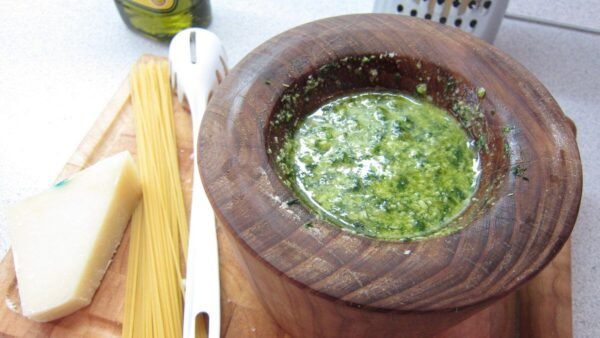
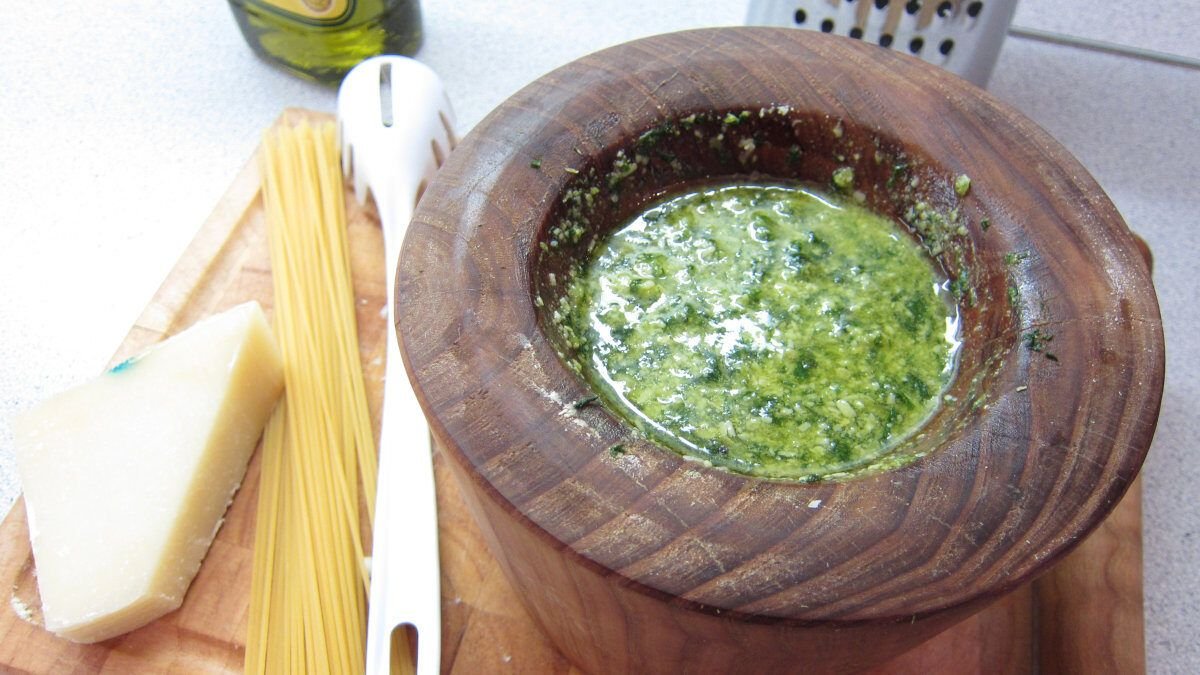
Making pesto with an immersion blender, blender, or food processor makes things even easier than you might imagine. The original recipe calls for a marble mortar; I used a wooden one. It doesn’t matter which method you choose, modern or traditional, as long as you have a way to grind the ingredients.
Chef’s Tip: Do not grind it too thoroughly, as we do not want a completely smooth sauce.
The original pesto recipe calls for Parmesan cheese, meaning Parmigiano Reggiano or Grana Padano. You can buy either at pretty much any grocery store. I suggest buying a block of Parmesan and grating it yourself. Sometimes you can also find Pecorino, mainly in larger supermarkets, cheese shops, or online. It is made from sheep’s milk, and its flavor is similar to Parmesan. It can be used instead of Parmesan if you prefer.
It’s essential to choose a strong, salty hard cheese. Pine nuts are also available at most large stores, but if you can’t get them, walnuts are a common substitute and the pesto will still taste delicious.
Homemade Pesto Tips
The amount in this recipe is enough for about 600 grams of pasta. It serves four as a main dish, or eight as an apetizer.
The essence of the recipe is to ‘mash’ the ingredients. That’s why the traditional method, using a mortar and pestle, will usually give superior results.
The word “pesto” itself points to this, as it comes from the Italian verb ‘pestare,’ which literally means to crush or pound. Traditionally, pesto is prepared by crushing the ingredients in a mortar with the circular motion of a wooden pestle. Do it gently, never too hard. Italians say it is as much about an emotional approach to food as a physical one. As you work with the pesto, you will start to feel when it needs firmer mashing and when a gentler touch is required.
Adjust the salt to your liking; it helps the flavors develop. Remember that the two cheeses you add to the pesto are also salty.
If you prepare your pesto with an immersion blender or a food processor, you can put all the ingredients in at once. To get the right consistency, use the pulse function to mash the ingredients and avoid continuous blending.
Great Ways To Use And Serve Pesto Genovese
Italians use pesto as a sauce. Pesto pasta is the most popular dish made with pesto. It’s simple, which is what makes it so perfect.

Another widespread use of pesto Genovese is as an ingredient in minestrone (Italian vegetable soup), to which Italians often add a bit of pesto. You can also use pesto to rub meat before grilling or as part of bruschetta, a delicious appetizer popular in Italy and throughout Europe.
If you make the effort to prepare homemade pesto Genovese, it is worth making it fresh. As with many other foods, pesto can also be preserved. You can simply freeze it or put it into jars. If you plan to preserve it in jars, pour a layer of olive oil on top and/or sterilize it in hot water. I should note, though, that I’ve never preserved homemade pesto myself; these tips come from Italian food blogs. My best advice is to eat your homemade pesto Genovese fresh. It’s so delicious that I’m sure it won’t last long!
Authentic Pesto Genovese
Ingredients
- 2 cups basil leaves fresh, 50 g
- 7 tbsp olive oil extra virgin, 100 ml
- 6 tbsp Parmesan cheese grated
- 2 tbsp Pecorino cheese grated
- 2 cloves garlic
- 1 tbsp pine nuts
- salt
Instructions
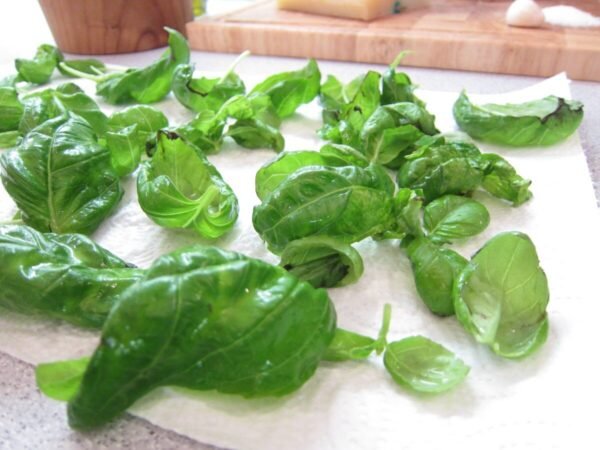
- Wash the basil leaves and dry off the excess water by placing them on paper towels or a kitchen towel. Grate the cheese, and crush the garlic cloves slightly with a knife to make them easier to mash in the mortar.

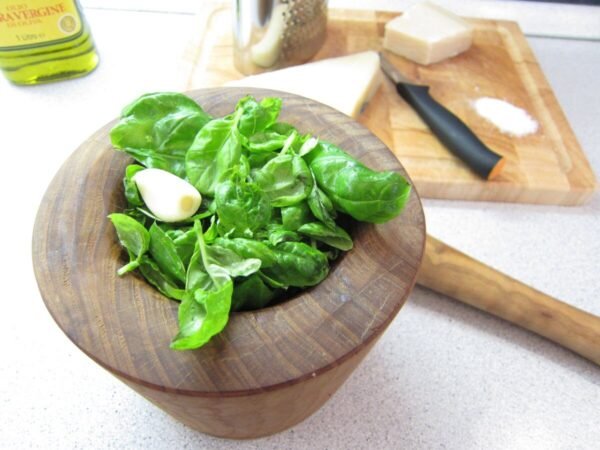
- Put the basil leaves and garlic into a mortar or blender and start mashing them.
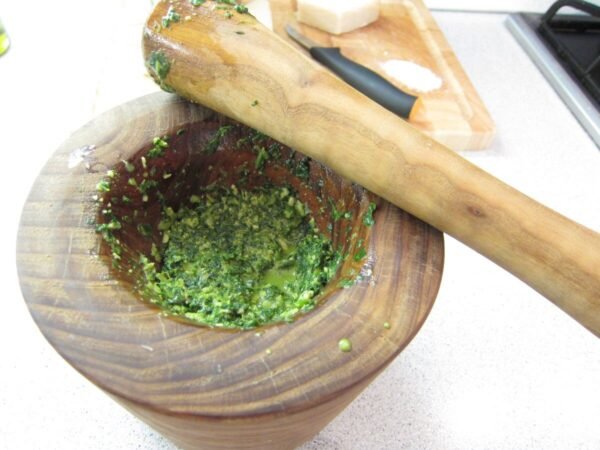
- Once you get a mushy consistency with some bits of basil leaf still visible, add the pine nuts and continue mashing. The pine nuts will absorb much of the moisture from the basil, and the mixture will start to look more and more like real pesto Genovese.
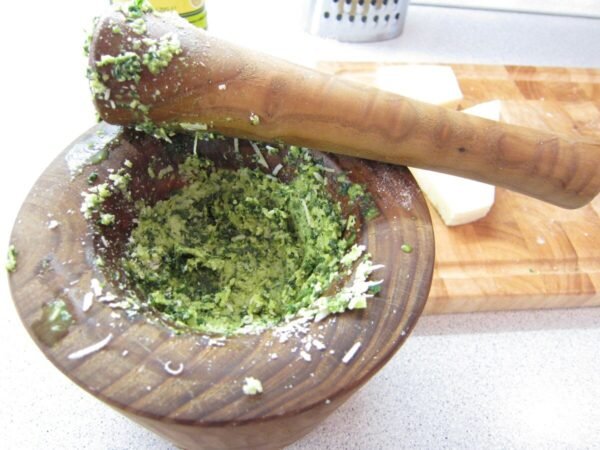
- Add the grated cheese and continue mashing. At the end of this stage, your pesto will be quite dry.
- At last, add the extra virgin olive oil and stir thoroughly.