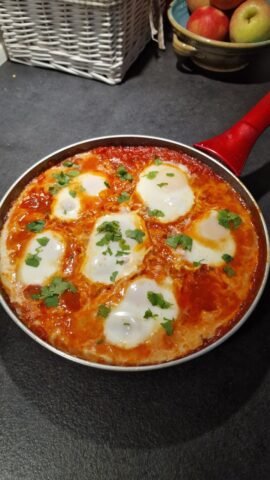
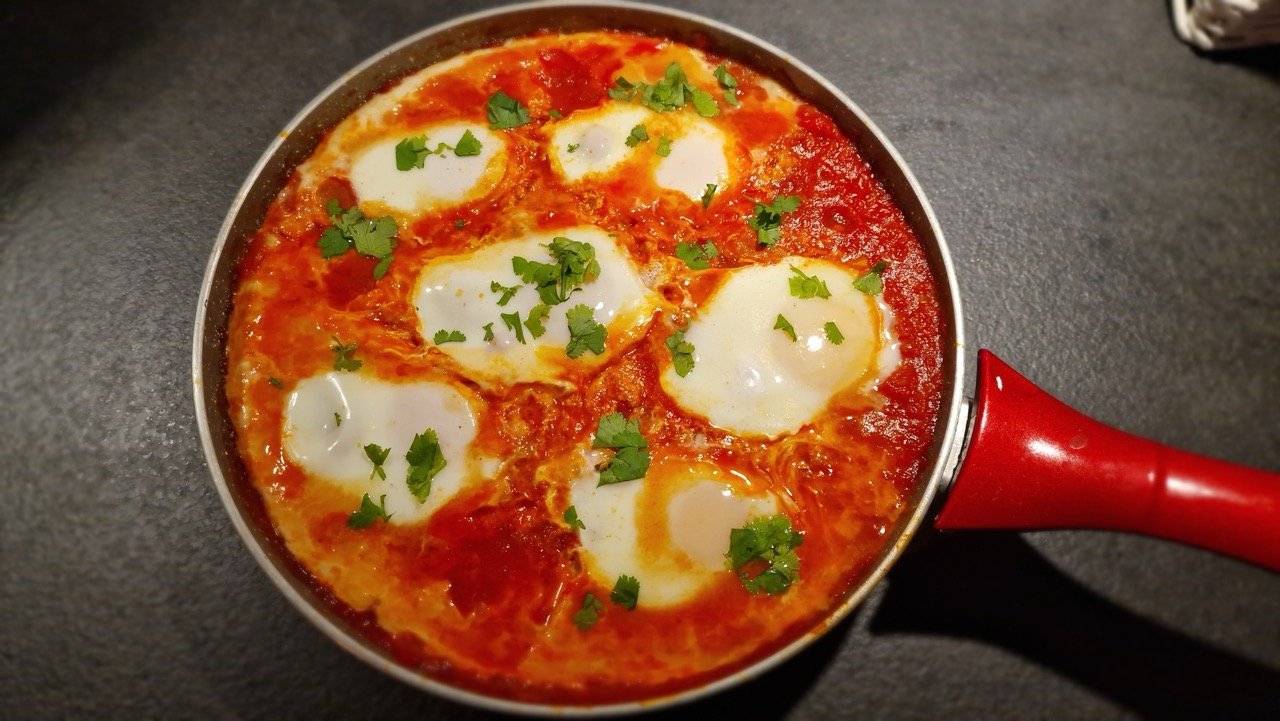
For a long time, I wanted to make and publish a real, original shakshuka recipe here on Schnitzel in a Wok, where, after all, my mission is to present recipes from international cuisines in versions that are as authentic as possible. (You may also see the name spelled shakshouka or chakchouka.)
Whenever I do this, I set out on a little research journey—often, of course, only through the mysteries of the internet—to find a version that is not only delicious but can preferably also be called authentic.
I did the same when searching for the original shakshuka recipe. I’ve seen plenty when it comes to “original” recipes, but I wasn’t necessarily expecting what I found here.
Where Does the Original Shakshuka Come From?
If you’re familiar with shakshuka, chances are you’ve encountered it as a skillet of eggs poached in a spiced tomato sauce. This version has become popular internationally, particularly through Israeli cuisine, where shakshuka is a beloved breakfast dish.
But dig a little deeper into the recipe’s origins, and you’ll come across its Maghrebi, or Northwest African, roots.
I have a habit that whenever I’m researching a traditional recipe from another country, I don’t stop at the English-language versions that tend to dominate search results. Instead, I look for recipes from the region where the dish originated, preferably written in the local language. I try to find the versions that people actually prepare and eat there, rather than just the ones that have become popular internationally.
Of course, I could move to Tunisia for six months and go door to door discovering how locals make their original shakshuka. I’m sure it would be fun, and I’m sure plenty of people would argue that this is the only way to find a truly authentic recipe. But still…
This Is Where the Complications Began
We can basically agree, right(?), that shakshuka is a dish of eggs poached in a spiced tomato sauce. At least from the perspective of the version most familiar to us through English-language cookbooks, restaurants, and food blogs.
But the first surprise came when I started researching Moroccan recipes. Instead of consistently finding the familiar egg dish, I encountered taktouka (sometimes spelled tektouka), a cooked pepper-and-tomato salad. The ingredients were certainly familiar, but the dish wasn’t quite what I had expected.
Then there’s Tunisian shakshuka, which is already more similar to the internationally known version. But whole eggs poached in the sauce aren’t necessarily as central to every preparation as you might think. In Tunisia, you’ll find variations prepared with merguez sausage, kadid (preserved dried meat), potatoes, or even fish balls.
In Algeria, chakchouka often resembles a vegetable stew, somewhat like ratatouille, rather than the egg-centered breakfast dish we’re familiar with. Eggs may be omitted altogether, or sometimes stirred into the vegetables instead of being left whole. There’s also a popular preparation in which the vegetables are grilled first, then peeled and cooked in oil.
And let’s add one more complication that shouldn’t really surprise anyone: even within these regional traditions, there are about as many variations as there are cooks. The same is true of Israeli recipes, even though they’re generally closest to the shakshuka that’s become popular around the world.
And What About Turkish Menemen?
Here’s another interesting comparison. If we’re talking about tomatoes, peppers, onions, and eggs cooked together in a skillet, we shouldn’t forget Turkish menemen.
It’s a traditional Turkish dish made with many of the same basic ingredients. But unlike the internationally familiar shakshuka, the eggs in menemen are generally stirred into the tomato-and-pepper mixture rather than poached whole on top.
The similarities are obvious, yet the two dishes have their own identities and culinary traditions.
And they’re hardly alone. Think of Italian peperonata or French ratatouille. Different dishes, different traditions, but many familiar ingredients and cooking techniques.
So much for the idea that we can always find one definitive original recipe and neatly assign every combination of ingredients to a single national cuisine.
How Recipes Change When They Travel
One of the things I genuinely appreciate about American food culture is its openness to international cuisines. Immigrant communities, restaurants, chefs, home cooks, and food writers have introduced countless dishes to audiences who might otherwise never have discovered them.
And the internet has made this process even faster. Shakshuka is a perfect example: a dish with North African roots, widely embraced in Israeli cuisine, that has become a familiar breakfast and brunch option in restaurants and home kitchens around the world.
There’s absolutely nothing wrong with that. Quite the opposite.
But there’s another side to this process, and it’s something I regularly encounter when researching traditional recipes.
A food blogger or content creator discovers a dish, adapts it to local tastes or readily available ingredients, perhaps adds a few personal touches, and publishes it as a recipe. So far, so good. That’s how cooking evolves, and some of these adaptations are undoubtedly delicious.
The problem begins when that adapted version is presented as the authentic original, without much understanding of the dish’s history or how people actually prepare it in its region of origin.
Sometimes an ingredient becomes standard simply because a few popular recipes included it. Sometimes a cooking technique gets simplified or changed, and after enough websites repeat it, the new version starts to look like the original.
And of course, online recipes are written for an audience. Familiar ingredients, attractive photos, and dishes that fit current food trends naturally tend to get more attention than obscure regional preparations that may seem less approachable.
None of this means that modern adaptations are bad, or that we shouldn’t experiment with traditional dishes. I certainly don’t think that.
But publishing a delicious variation is one thing. Presenting it as the one and only authentic version of a dish, especially without understanding its origins, is something else entirely.
Food traditions deserve a little more respect than that.
So Then, What Is Original Shakshuka Like?
Taking all of this into account, I think there are two possible answers to this question, and both can be true at the same time.
- There isn’t one single original shakshuka recipe. Like many traditional dishes, shakshuka belongs to a family of regional preparations that have developed over time. Ingredients, seasonings, cooking methods, and even the role of eggs can vary significantly from one country to another, and from one household to the next.
- There is, however, a recognizable international version of shakshuka. This is the version most English-speaking home cooks are familiar with: a flavorful tomato-based sauce, usually prepared with onions, bell peppers, garlic, and spices, with whole eggs gently cooked in the sauce at the end.
And that’s an important distinction.
The internationally popular version is generally made with lots of tomatoes, often onions and bell peppers, and seasonings such as cumin, paprika, and chili. The eggs are cracked directly into the thickened sauce and cooked gently, ideally until the whites are set but the yolks remain soft.
But even within Israeli cooking, which has helped make this version so widely known, there are recipes that leave out onions or bell peppers entirely.
Meanwhile, in North Africa, related dishes can look quite different. Moroccan taktouka is more of a cooked vegetable salad, Algerian chakchouka may include grilled vegetables or eggs stirred into the mixture, and Tunisian shakshuka can be enriched with meat, sausage, potatoes, or other ingredients.
Does that mean the familiar tomato-and-poached-egg version isn’t authentic? Not at all.
It simply means that authenticity isn’t always about identifying one definitive set of ingredients and declaring every other version wrong.
Anyone can prepare shakshuka in the way they enjoy most. You can follow a traditional regional recipe, make the internationally popular version, or add your own personal touches.
A dish doesn’t become delicious or disappointing because of what we call it.
But I do think it matters whether we understand the culinary traditions behind what we’re cooking. And when we present a recipe as authentic, we should be able to explain which tradition it represents.
After all, respecting the origins of a dish doesn’t prevent us from enjoying new variations. It just helps us appreciate both the original traditions and the ways they’ve evolved.