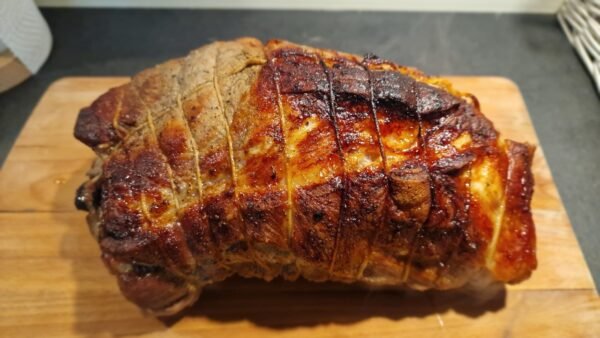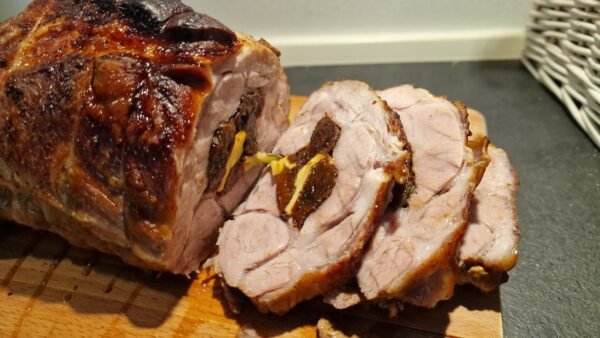
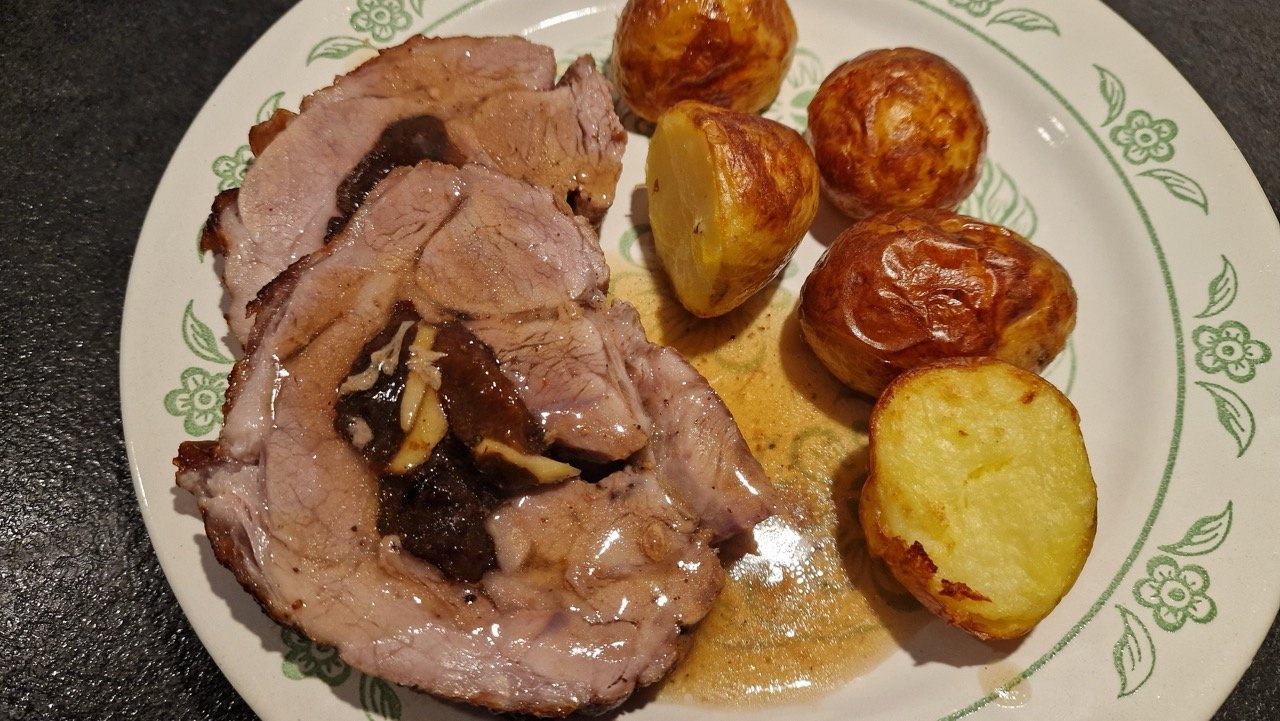
The Danes love pork roasts cooked in one piece. Rullesteg [pronounced roughly hoo-luh-sty] is a great example of that. The name of the dish literally means rolled roast, but it is much more than that. It’s a wonderfully juicy pork neck roast stuffed with prunes, and it is not nearly as complicated to make as it may sound at first.
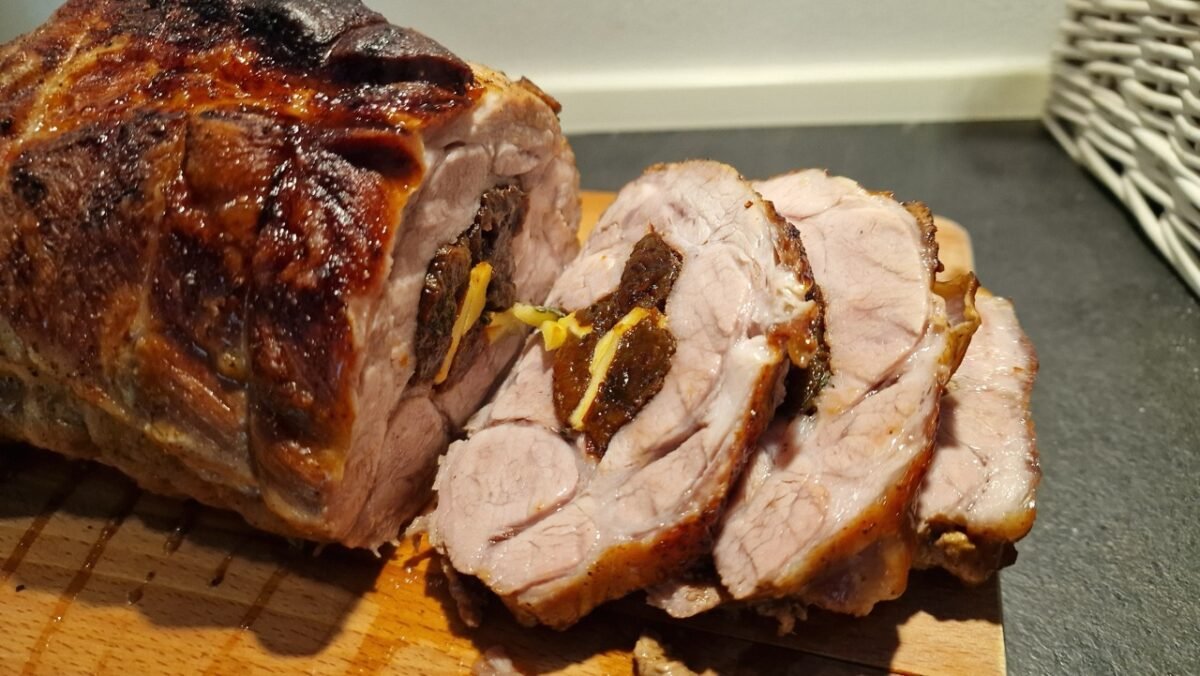
Unfortunately, this dish is not nearly as well known internationally as it deserves to be, even though it can bring fantastic flavors to the table. Although meat stuffed with prunes already feels festive in itself, in Denmark it is considered quite an everyday dish. Of course, it is not served every day, but outside the holidays it could easily be served for a normal weekend dinner too.
Rullesteg at Home
This dish really is not well known internationally at all—I only came across it by chance myself. Once, in a supermarket in Denmark, I saw a beautifully rolled and tied piece of meat. Looking through the ingredient list, I was surprised to notice the prunes. There was practically nothing else in that version. But somehow the whole thing appealed to me, so I bought it and roasted it as described in this recipe.
The flavor was heavenly, though at the time I did not yet know that the seasoning I am sharing with you now could bring even more out of this dish. But since I wanted to publish the recipe, I had to look into it more closely and come up not just with a store-prepared version, but with a recipe made completely from scratch.
Because while in Denmark it is fairly common to find this meat already prepared—stuffed, rolled, and tied—in stores, around the world that is practically impossible precisely because it is so little known. So if someone elsewhere wants to try these flavors, they really do have to take it on themselves and make the entire rullesteg from the point of cutting open the whole pork neck. Which is not as complicated as it may sound at first.
“Stuffing” the Meat
Perhaps the only challenge in this recipe is “stuffing” the meat. Stuffing is in quotation marks because, in the true sense of the word, this is not stuffed meat—even if it looks and behaves exactly like it. This is rolled meat, with prunes and very often apples inside.
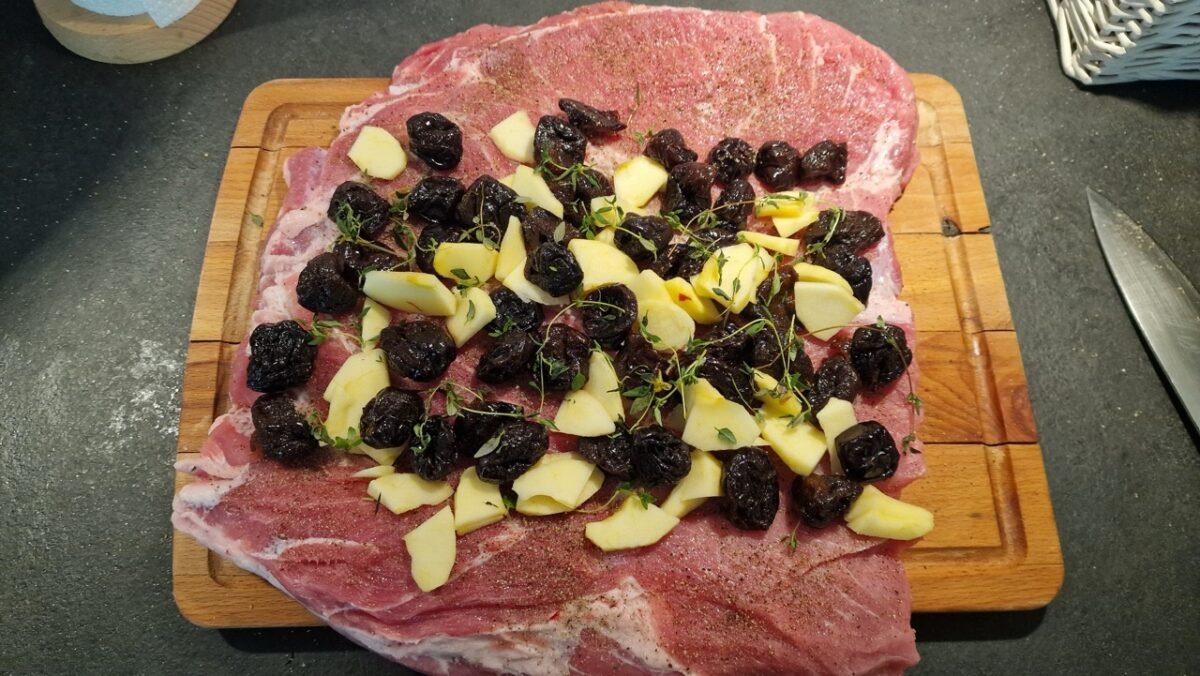
So the actual challenge is opening up the whole pork neck properly, laying it flat, and later rolling it up and, most importantly, tying it. It is no coincidence that, as I wrote, in Denmark this popular dish can very often—especially in the winter months and before Christmas—be bought in stores already prepared, rolled, and tied. But if that option is not available to you, there is no need to worry. With a little courage, rullesteg is relatively easy to make.
Opening Up the Meat
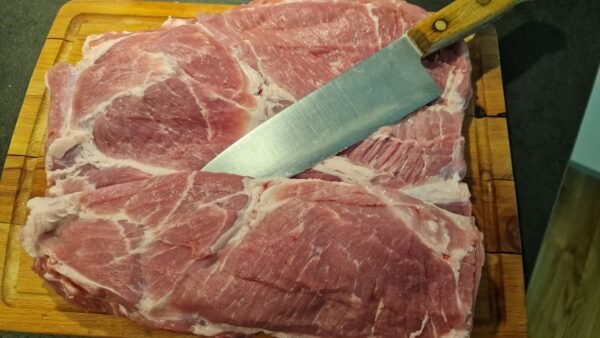
You need to cut, or rather open up, the whole pork neck so that you can lay it flat and then place the prunes on it.
Fortunately, pork neck itself has a structure that almost naturally lends itself to this roll-like cut. If you turn it with the “nicer” side facing down, you will immediately see that one side opens up a little, and that is where you can start cutting. If you look at it from the side, you will also see that it has this roll-like structure.
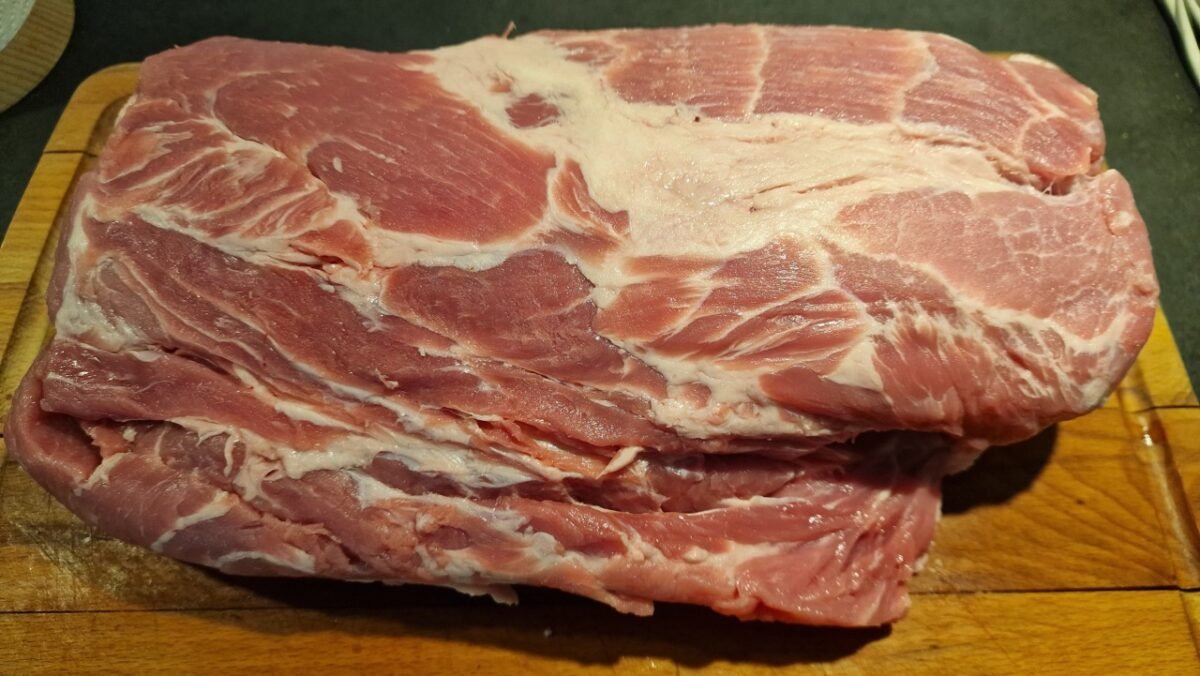
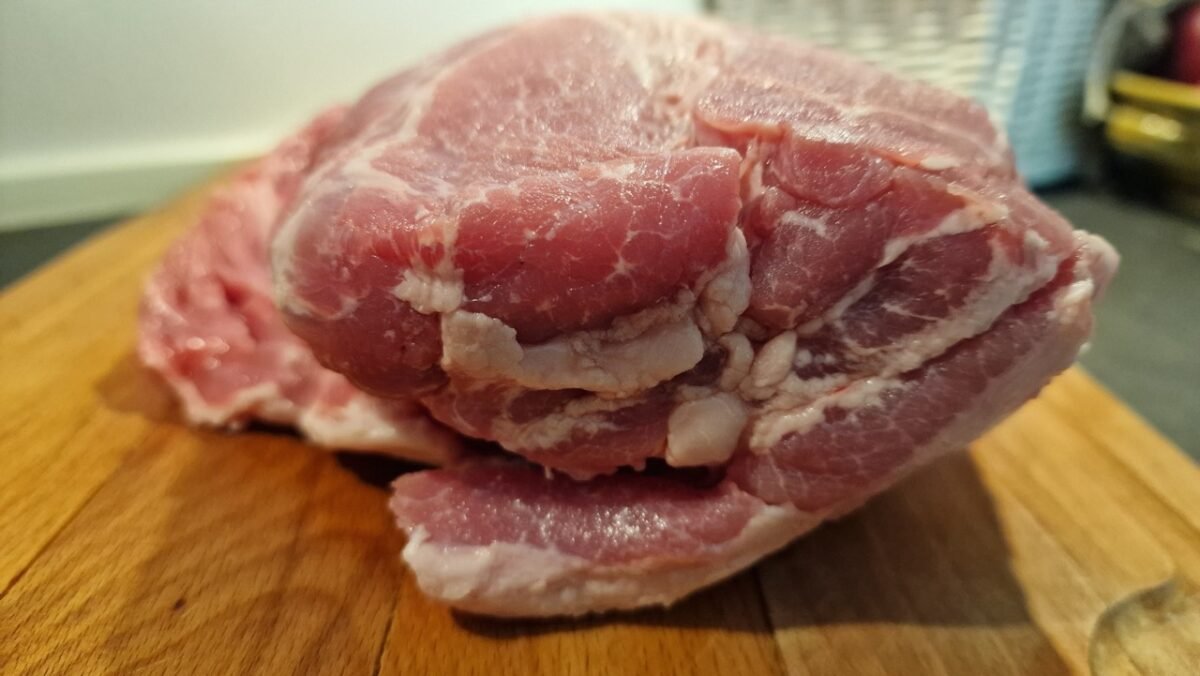
Work with a very sharp knife, starting to cut continuously along the slightly separating part. You will end up with a piece of meat about 1¼-1½ inches (3-4 cm) thick. Be careful not to cut all the way through, because the pork neck needs to stay in one piece.
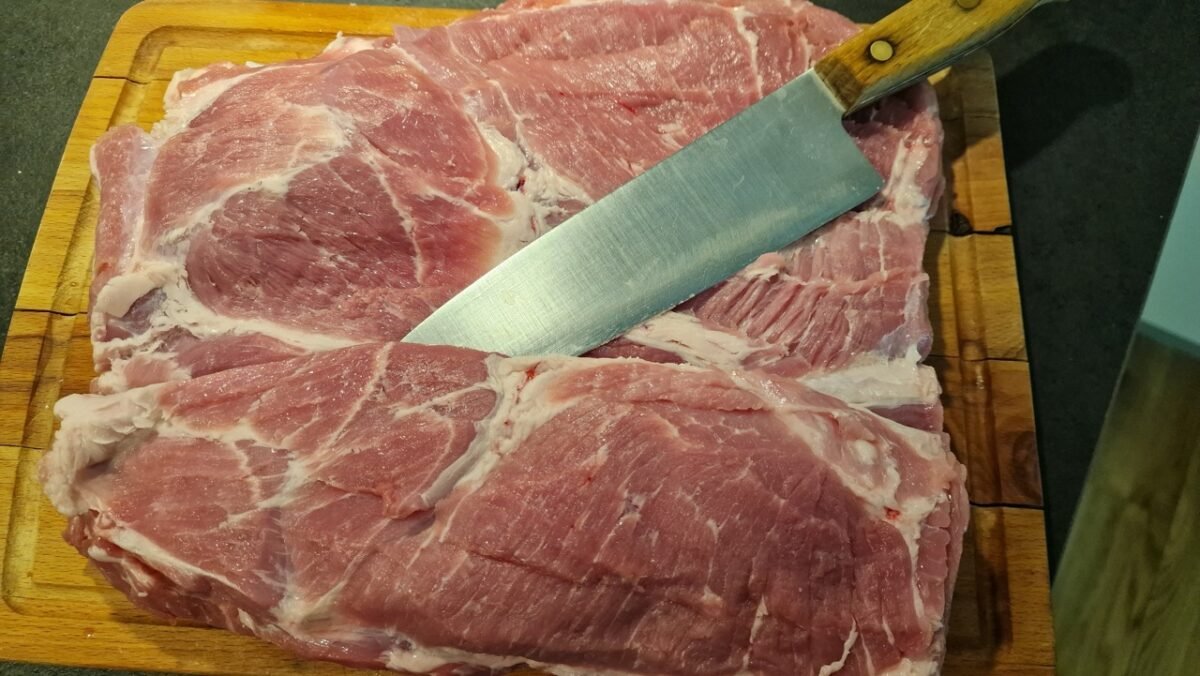
Once you reach the end, there will still be a slightly thicker middle section. Cut into this as well in such a way that, in the end, you can lay out the meat in one piece, roughly evenly 1¼-1½ inches (3-4 cm) thick.
Tying the Meat
Tying the meat may be the biggest challenge if you have never done anything like it before. But there is no need to be intimidated—we are not preparing meat for a butcher shop or an exhibition. The only important thing is that it stays together during roasting. And for that, you do not necessarily need to use a professional tying technique. You will, of course, need butcher’s twine. You can read more about tying meat by clicking the link, with pictures showing the process.
First, roll up the stuffed meat as much as possible back into the same shape it originally had.
Then tie a loop with a simple knot at the end of the butcher’s twine. Pull the entire length of twine through this loop, and place the huge loop that forms underneath the meat lengthwise. Pull the whole thing tight so it holds the meat snugly lengthwise. Because the twine has been passed through the loop, this will happen by itself: it will tighten, but it will not get stuck.
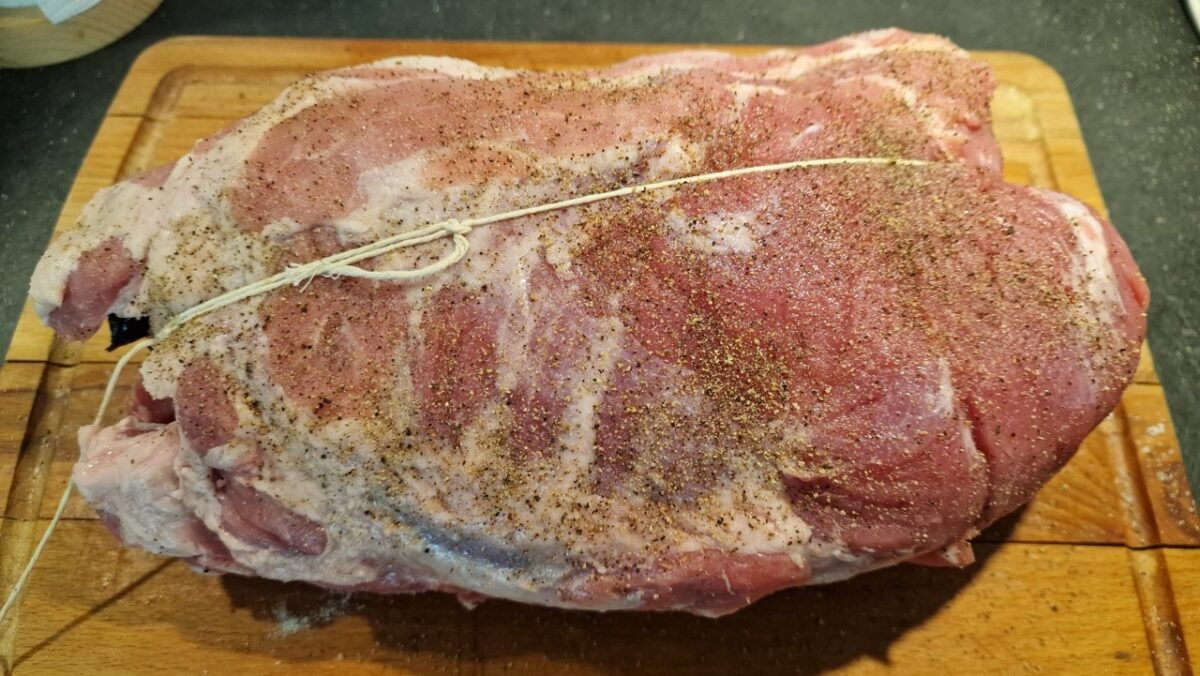
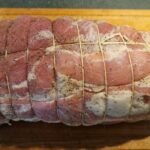
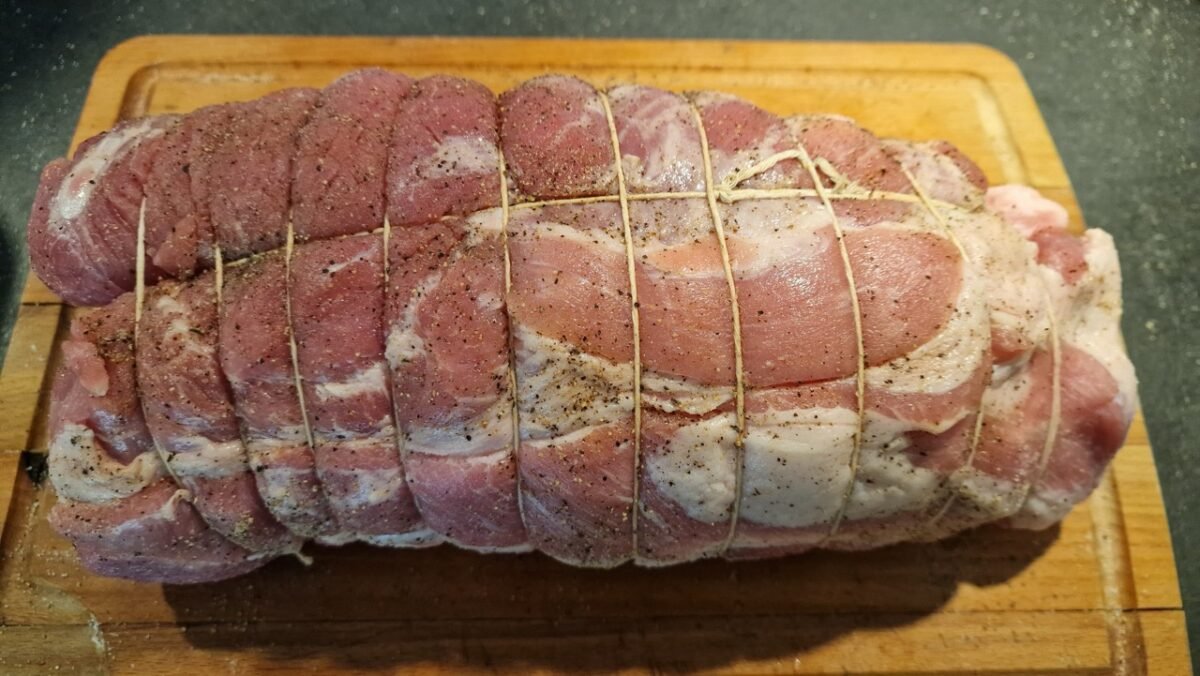
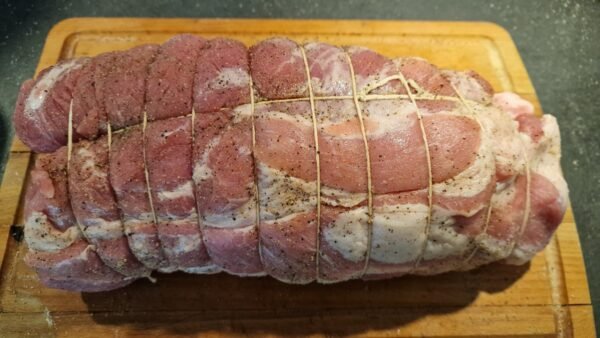
Now wrap and tighten the meat crosswise about every 1 inch (3 cm). You do not need to cut the twine; simply wrap it around crosswise and pull it tight. Underneath, move it about 1 inch (3 cm) farther along, wrap it again, and pull it tight. Continue this way all the way to the end of the meat. It is important to pull the twine tight each time so it holds the meat. At the end, simply tie a knot and cut off the loose end of the twine.
What Goes Into the Filling?
The essential ingredient in rullesteg is prunes. You cannot leave them out; in fact, you can make this heavenly stuffed meat roll with only prunes as the filling, and that is completely authentic too.
Another ingredient that very often goes into it is apple—together with the prunes. In fact, in at least two-thirds of modern Danish recipes, apple appears among the ingredients in addition to the prunes.
Thyme is also characteristic of the seasoning. This is a relatively simple dish in terms of flavoring; apart from salt and pepper, the meat does not really need any other spices. But dried or fresh thyme is very often added to the filling, and let’s be honest, it goes incredibly well with this combination.
It is important that, as with any larger piece of meat, you use enough seasoning here too. Be generous with salt and pepper on both sides; the meat can take a lot of both.
Why Simple Rullesteg?
This recipe presents a very simple version of traditional Danish rullesteg. Meat stuffed with prunes is, of course, not the simplest thing to assemble, and we are not compromising on that part—the rolling with prunes.
What makes this simpler compared with most traditional rullesteg recipes is the roasting method. Here, the meat is roasted only in a simple stock, and this can even be replaced with a bouillon cube, with a little Worcestershire sauce added. The sauce left after roasting is simply thickened with starch. Even so, the final result is wonderfully juicy and flavorful—try it!
Serving Rullesteg
Rullesteg is a whole roast stuffed with prunes, and as such it is usually served fresh and hot. It makes a worthy menu item for any family gathering, more special dinner, or festive occasion.
In this case, for example, whole roasted potatoes or boiled potatoes go especially well with it, and you can serve it with the sauce described in the recipe.
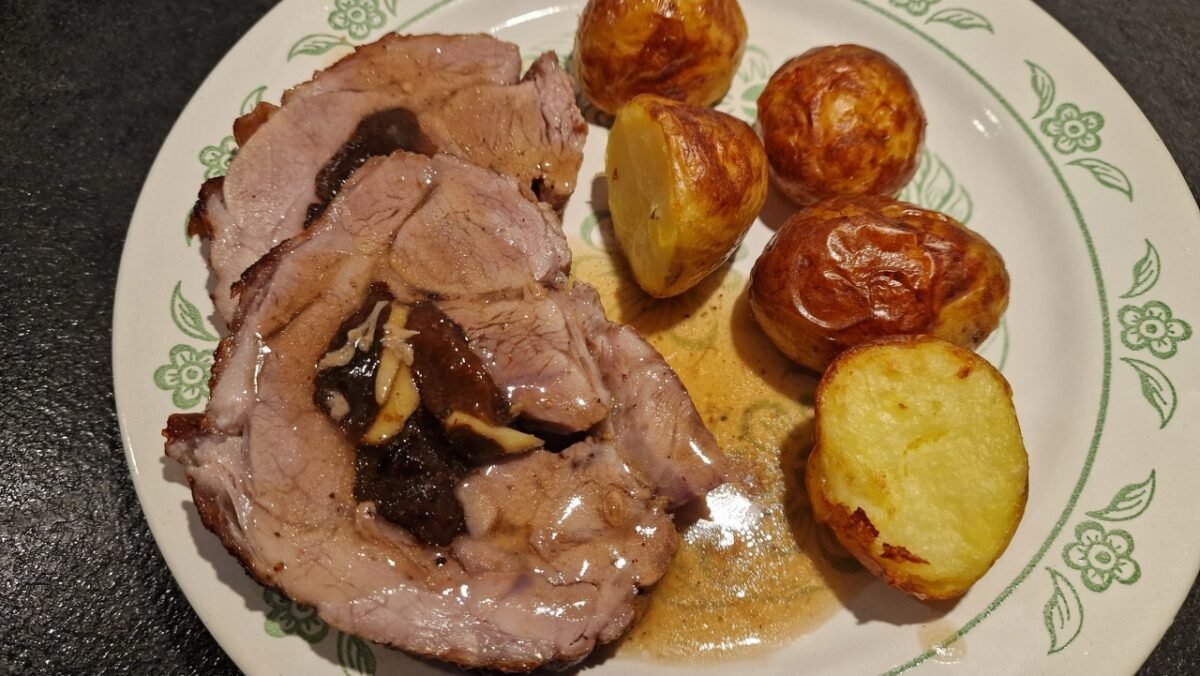
But it is also perfect cold on sandwiches, for example with mustard and cabbage—and authentically Danish, too. And there is no need to worry that there will not be any left to eat that way: a whole pork neck is huge, and unless you are feeding a family of ten, you will certainly have some left for another occasion.
Meat Stuffed With Prunes for Christmas
Rullesteg, this Danish meat stuffed with prunes, is not specifically a Christmas dish in Denmark. But that is true mostly in the sense that it is basically eaten all year round. At Christmas, Flæskesteg is much more typical there—the two dishes are not to be confused—but no Dane will criticize you if you serve rullesteg on Christmas Eve or as part of a Christmas menu.
After all, meat roasting whole for a long time in a hot oven, the prunes and apple, and the slightly more special nature of the dish all make this recipe perfectly worthy of being part of a beautiful, cozy Christmas menu.
Simple Rullesteg
Equipment
- Butcher’s twine
- Roasting pan or baking dish
- saucepan
Ingredients
- 1 whole pork neck roast about 4.9-5.3 lb (2.2-2.4 kg)
- About 10.5 oz prunes 300 g prunes
- 1 apple optional
- 2 cups water 500 ml
- 1 bouillon cube or chicken stock instead of the water and bouillon cube
- 1 tbsp Worcestershire sauce 15 ml
- 1 tbsp oil or lard
- 1 tbsp butter
- Salt
- Ground pepper
- Thyme dried or fresh, to taste
- 1 tbsp starch
Instructions
Preparing the Meat
- Preheat the oven to 400°F (200°C), using regular top and bottom heat. In a saucepan, bring the stock to a boil, or bring the water to a boil and add the bouillon cube. Add the Worcestershire sauce and mix well.
- Cut into the whole pork neck lengthwise with a very sharp knife so that you can lay it out about 1¼-1½ inches (3-4 cm) thick. The structure of pork neck almost naturally lends itself to this roll-like cut. If you turn it with the “nicer” side facing down, one side opens up slightly, and that is where you can start cutting. Work in such a way that you begin cutting continuously along the slightly separating part. Once you reach the end, there will still be a slightly thicker middle section. Cut into this as well so that, in the end, you can lay out the meat in one piece, roughly evenly 1¼-1½ inches (3-4 cm) thick.

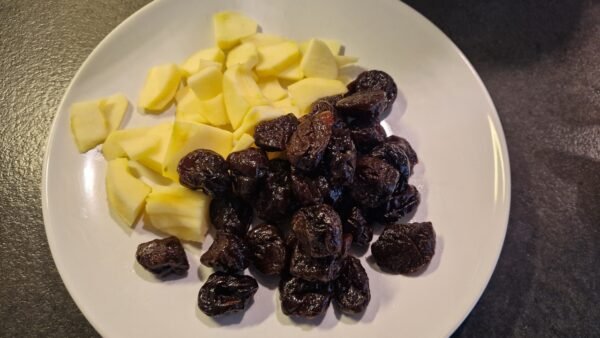
- Peel and core the apple, cut it into ¼-inch (0.5 cm) slices, then cut the slices in half. Set out the prunes.
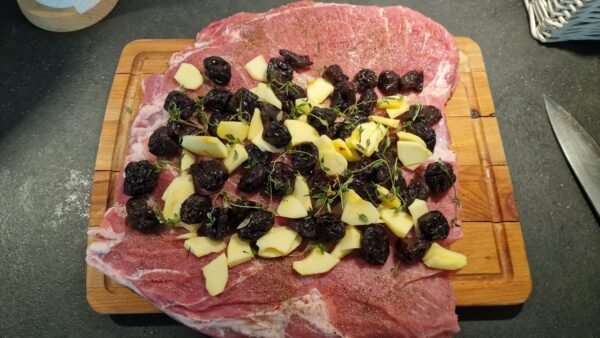
- Season the inside of the meat generously with salt and pepper. Spread the prunes and apple evenly over the center section. Season with dried or fresh thyme.
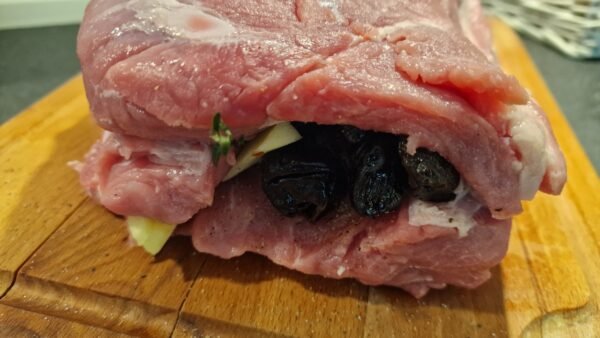
- Roll up, or rather fold back, the two sides of the meat in the order in which you laid them out. As much as possible, roll it back into the same shape it originally had.
- Tie the meat once lengthwise, then tightly crosswise about every 1 inch (3 cm), so it stays together. Tie a loop with a simple knot at the end of the butcher’s twine. Pull the entire length of twine through it, and place the huge loop that forms underneath the meat lengthwise. Pull the whole thing tight so it holds the meat snugly lengthwise. Crosswise, about every 1 inch (3 cm), using the same continuous length of twine, wrap and tighten the meat. You do not need to cut the twine. Each time, pull the twine tight so it holds the meat. At the end, simply tie a knot and cut off the loose end of the twine.
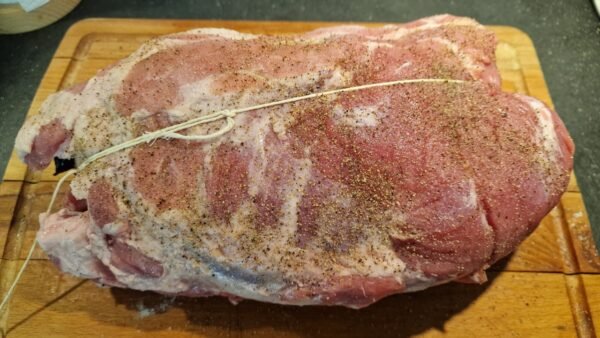
- Season the tied meat on the outside as well with salt and ground pepper.
Roasting the Meat
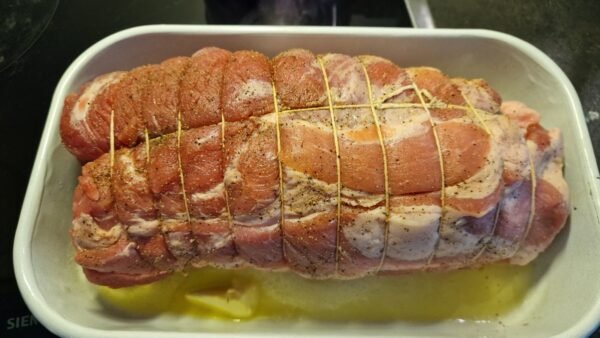
- Place the roasting pan in which you will roast the meat on the stovetop, and melt the butter in the oil or lard over high heat.
- Put the meat in and brown it for 1 minute on each side.
- Pour the heated stock underneath the meat and put it in the oven.
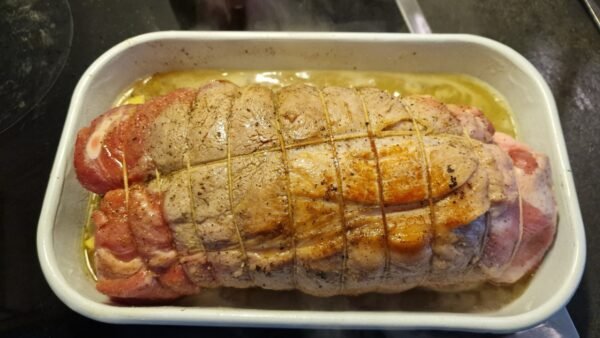
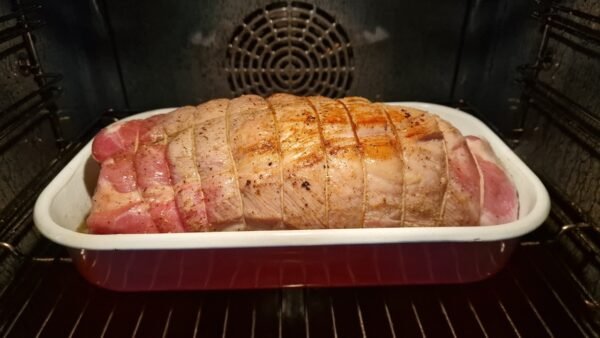
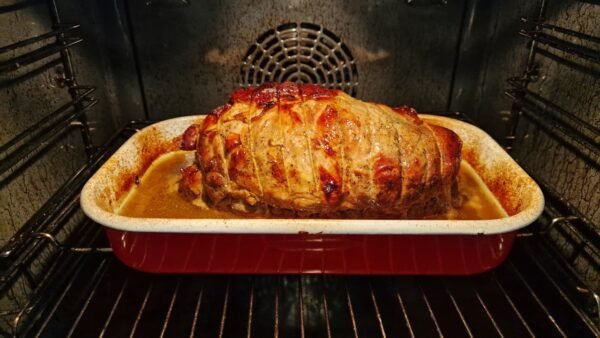
- Roast the meat for 2 hours. Meanwhile, baste it with its own juices every 15-20 minutes.
Final Assembly
- Take the meat out of the oven and out of the roasting pan, and let it rest on a cutting board for at least 10 minutes.
- In a small bowl, mix the starch with a little cold water.
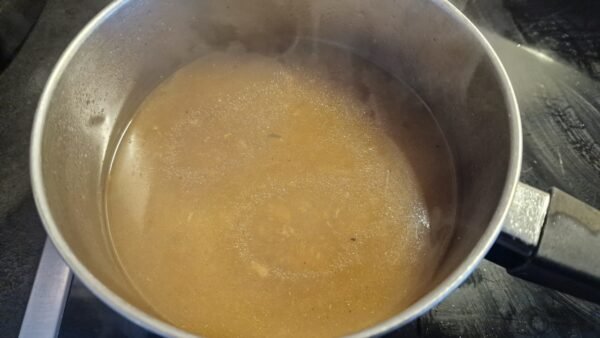
- Pour the liquid from under the meat into a saucepan and bring it to a boil. Pour in the starch mixture and boil it with it. If necessary, season with salt, pepper, and Worcestershire sauce. You can continue simmering it gently over low heat here, and it will become even thicker.
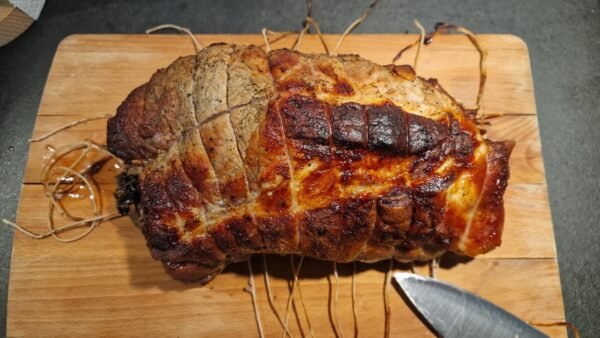
- After 10 minutes, cut the butcher’s twine off the meat with a sharp knife and remove it.
- Slice the meat with a sharp knife, and serve it immediately with a side dish and the sauce.