
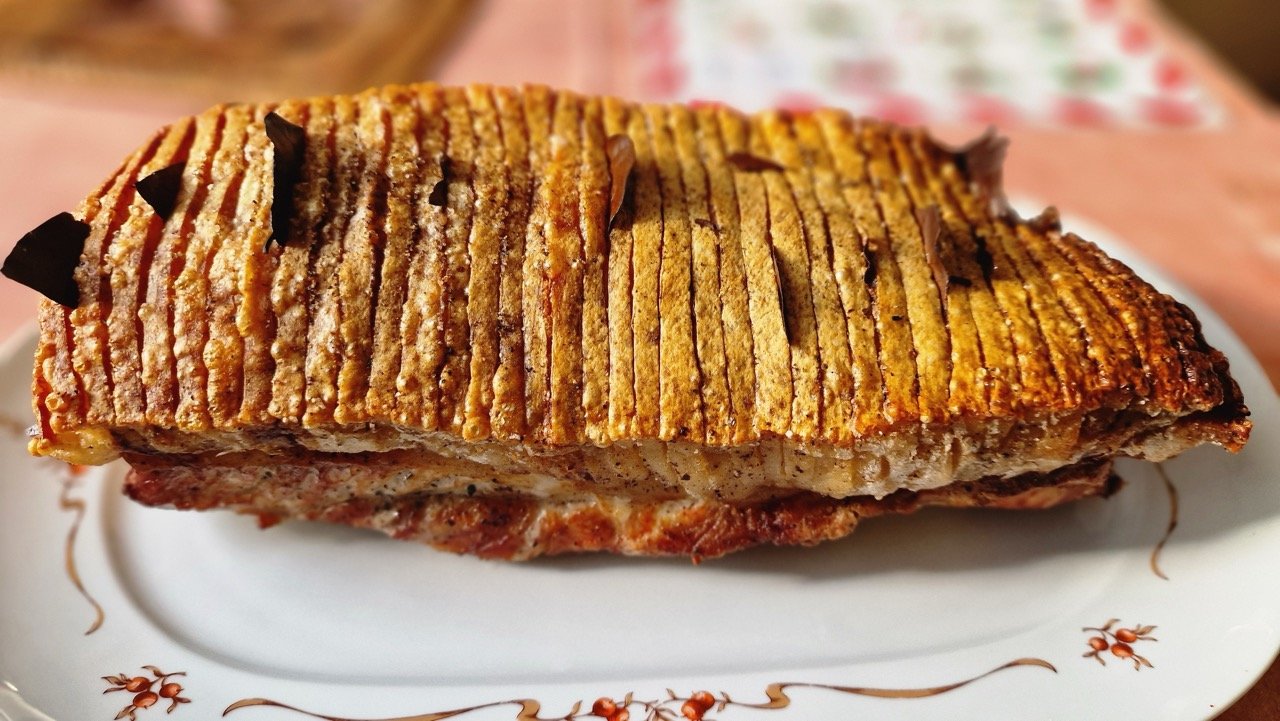
Flæskesteg, this crispy skin-on pork loin roast may be Denmark’s most popular national recipe. It’s made and happily eaten all year round, but it’s also the most popular Danish Christmas dish.
Making it is nowhere near as complicated as it may seem at first—or even after tasting that divinely crispy skin. In fact, even though Danes are said to practically go to war at Christmas over who can make the crispier skin, you can prepare and serve this dish surprisingly well if you follow the recipe.
It’s perfect hot or cold—just don’t ask me how to pronounce its original Danish name, flæskesteg. 😅 Roughly: fless-keh-sty—though perhaps no one except a Dane can pronounce Danish words correctly.
Serving Flæskesteg
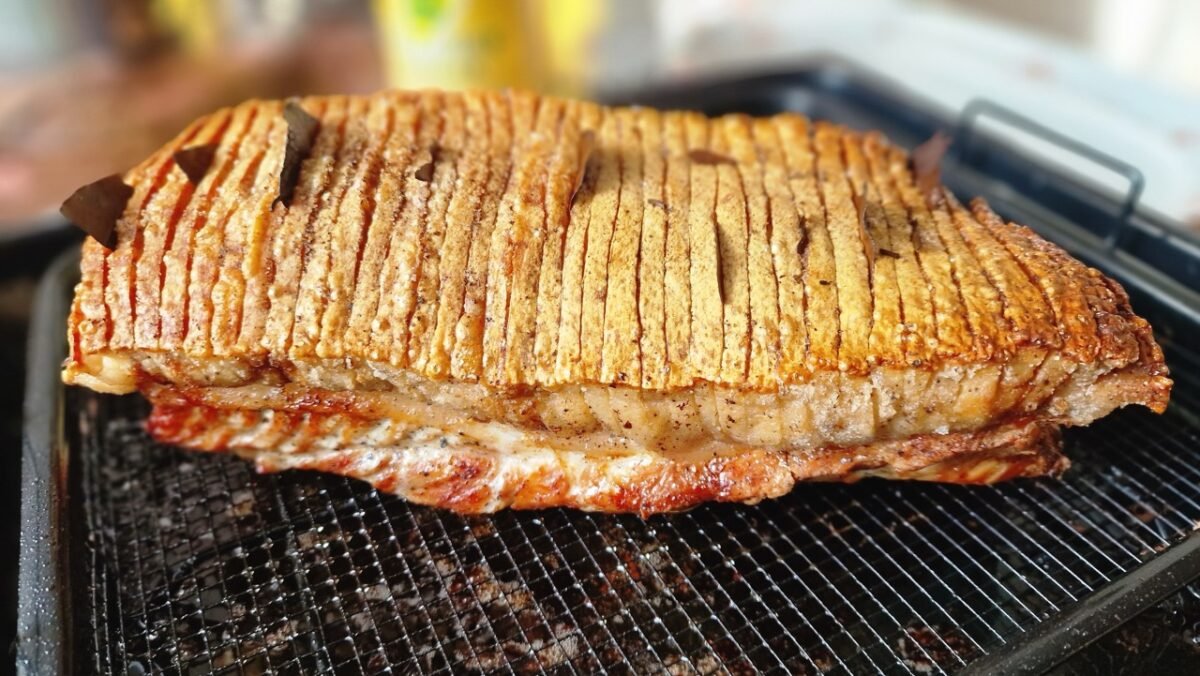
Flæskesteg can be served hot or cold. In both cases, cut it into thin slices, following the score marks.
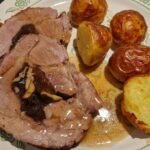
When served hot, it can be brought to the table whole and eaten in the more traditional way, with various side dishes. Mashed potatoes or sweet braised red cabbage go very well with it. I should mention that when it’s hot, it’s very hard to slice it neatly and thinly. You can also make a gravy from the pan juices to serve with it.
Cold and sliced, it’s perfect for any meal. In Denmark, it’s often eaten as a sandwich too, in a roll with gravy and braised red cabbage. This version is also sold as street food.
Making the Gravy
The best gravy for flæskesteg is made from its own pan juices.
For this, make sure to add water to the roasting pan under the meat at the beginning of cooking, as written in the recipe. Otherwise, the drippings will burn too much—and don’t ask me how I know that. 😅
When the meat is done, place it on a platter or plate that will catch the juices that run out. First, pour the excess fat from the roasting pan into a separate bowl, then place the pan on the stove and turn the heat to medium. Pour in a little hot water. As you stir, the stuck-on bits will loosen and dissolve. The roasting pan is very hot at this point, so work only with oven mitts!
Put a little of the fat into a skillet. If you want a really delicious sauce, sauté half a finely chopped onion or shallot in it—but this step can be skipped. Add about 1 tablespoon flour (or even a gluten-free flour blend), and toast it for one minute. Pour in the sauce left in the roasting pan, along with the juices released from the meat. Stir until smooth, and cook to your desired thickness. At this point, you may need to season it further with pepper and/or salt. If it happens to be lumpy, or if you added onion, strain it through a sieve.
Serve the sauce alongside the meat!
Part of Danish Culture
Flæskesteg, this crispy skin-on pork loin roast, is very much a part of Danish culture. It’s not only the most typical Christmas dish in Denmark, but it also appears very often on tables throughout the year, and it can even be bought from street vendors. I admit, unfortunately, this last option is becoming rarer—here too, the universal pizza-and-burger offering is slowly taking over everything.
But for Danes, this is practically the only way pork loin is eaten. In Denmark, it’s not very common to buy pork loin prepared any other way than with the skin on, already scored into strips at the store. In more extreme packaging—and very expensively—it’s even sold already seasoned, with salt, pepper, and bay leaves.
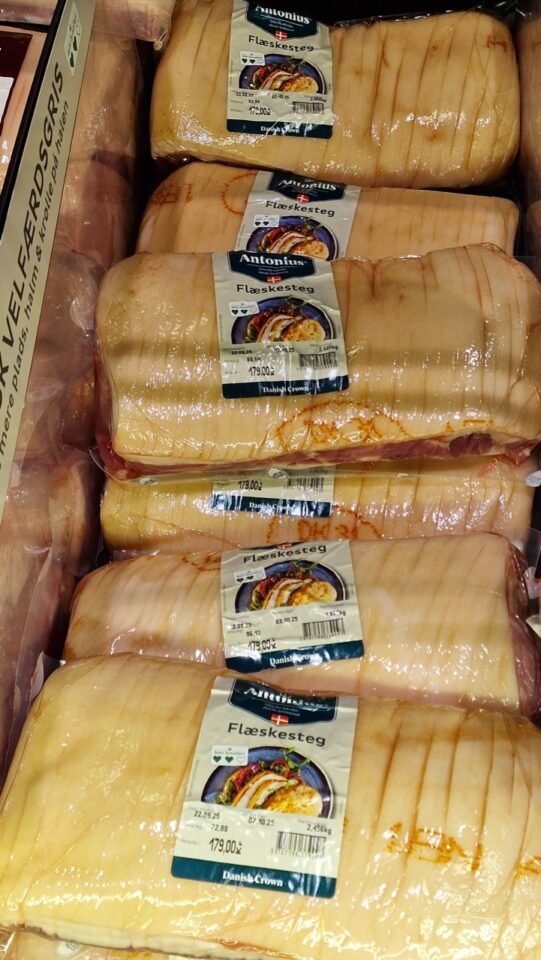
At Christmas, prepared, scored skin-on pork loin is one of the main loss leaders at grocery chains, sold at incredibly low prices. For example, as of 2025 (just for price comparison), this kind of skin-on pork loin costs 6.95–8.95 DKK (Danish kroner – about 1.25 EUR or 1.5 USD) per 1.1 lb (500 g) in promotional catalogs.
Danish Crispy Skin-On Pork Loin Roast (Flæskesteg)
Equipment
- Roasting pan with rack
Ingredients
- 4.4 lb pork loin 2 kg, skin on, boneless
- 3 tsp salt
- black pepper ground
- 10 bay leaves optional
Instructions
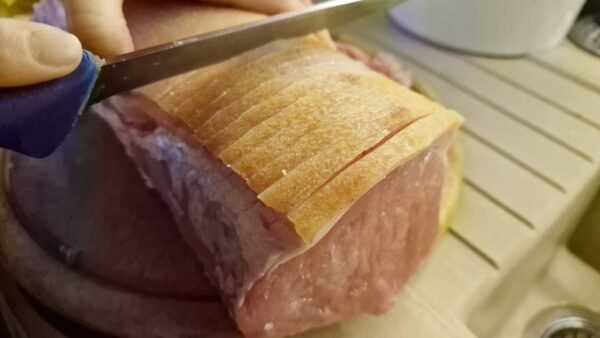
- One of the secrets to making truly delicious Danish Flæskesteg is the preparation. For this, pat the meat completely dry. Score the skin with a sharp knife into parallel strips about ⅓–⅜ inch (8–10 mm) apart, perpendicular to the length of the meat.Cut through the skin and the fat layer, but be careful not to cut into the meat.Preheat the convection oven to 255°F (125°C). If you don’t have convection, preheat it to 275–285°F (135–140°C).

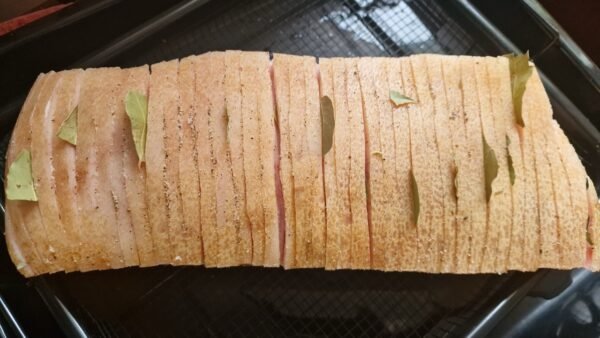
- Season the meat. Rub it with about 1 teaspoon salt per 2.2 lb (1 kg), working it very deeply into the skin side, all along the cuts. Sprinkle the meat generously with ground pepper and salt on all sides. Place bay leaves into the cuts, and put a few underneath the meat when you place it in the roasting pan.
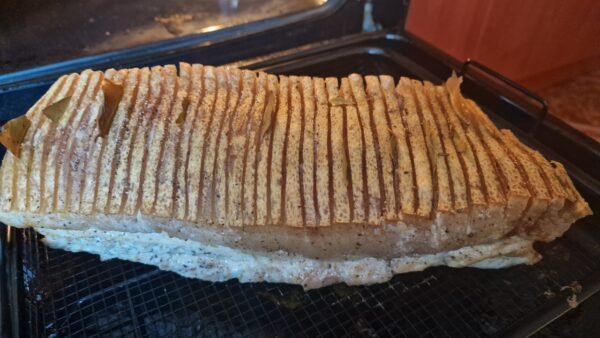
- Place the meat on a rack in the roasting pan with the skin facing up, and pour about 3 tablespoons (50 ml) water underneath it, so it does not touch the meat. Put it in the lower third of the oven and roast for 2 hours.If the skin on top of the meat is not level, place 1–2 halved potatoes underneath it. If it is level when you put it in, the skin will roast beautifully and crisp evenly.
- After 2 hours, move the roasting pan to the upper third of the oven, raise the temperature to 400°F (200°C) on regular top-and-bottom heat, and roast for another 40 minutes.Add more water to never let the juices dry under the meat.
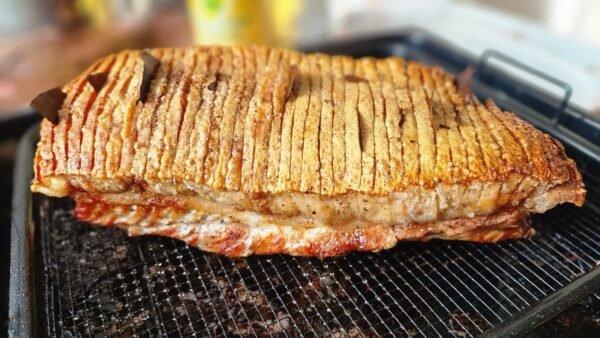
- Finally, roast it at 480°F (250°C) or under the broiler for 5 minutes. Watch it very carefully here so the skin does not burn. Remove it from the roasting pan, and let it rest for 10–15 minutes. Do not cover it.
- Making the Sauce
- When the meat is done, place it on a platter or plate that will catch the juices that run out. First, pour the fat from the roasting pan into a separate bowl, then place the pan on the stove, and turn the heat to medium. Pour in a little hot water. As you stir, the stuck-on bits will loosen and dissolve. The roasting pan is very hot at this point, so work only with oven mitts!
- Put a little of the fat into a skillet. If you want a really delicious sauce, sauté half a finely chopped onion or shallot in it—but this step can be skipped. Add about 1 tablespoon flour (or even a gluten-free flour blend), and toast it for one minute. Pour in the sauce left in the roasting pan, along with the juices released from the meat. Stir until smooth, and cook to your desired thickness. At this point, you may need to season it further with pepper and/or salt. If it happens to be lumpy, or if you added onion, strain it through a sieve.
- Serve the sauce alongside the meat!



1 thought on “Flæskesteg (Danish Crispy Skin-On Pork Loin Roast)”