Shakshuka (often also spelled shakshouka or saksuka) is primarily a Middle Eastern and North African dish that exists in countless versions. In recent years, it has also become famous in the Western world, especially in English-speaking countries, with what could be called a typical recipe formula.
We’ll untangle this geographical-culinary Gordian knot in just a moment, but for now, let it be enough to say that this is a very easy tomato-and-vegetable one-pan dish, often served with eggs cooked in it, poached-style.
If you love big flavors and you’re craving a tasty dinner or a hearty breakfast, then it’s time to get to know this shakshuka recipe and make it yourself!
The Geographical-Culinary Gordian Knot and the Story of My Own Shakshuka Recipe
All right, sleeves up, and let’s take a look at what this geography textbook-sized collection of place names in the first paragraph actually means, and how I arrived at this easy shakshuka recipe published here, which, in its own way, could even be called original. But if you don’t want to read a lot, click here for the recipe.
It all started with the fact that not only had I been craving good homemade shakshuka for years, but based on her experiences on business trips to Israel, my wife had also been nudging me for quite some time to make an authentic version. At first, this didn’t seem like much of a challenge. After all, shakshuka really is famous worldwide, so I figured I’d dive into the mysteries of the internet, find a truly original shakshuka recipe, make it, and we’d be done.
I had no idea what a task I had taken on. After just the first few glances, it became clear that not only is there no such thing as one original shakshuka, but practically every country has its own almost completely different recipe. And if we want to push the differences even a little, then essentially the version that the Western world knows as shakshuka barely exists in that form in many of the places where the recipe supposedly comes from.
If you’re thinking that this sounds complicated, you’re not alone. So much so that everything I gathered on the subject of shakshuka wouldn’t really fit into one recipe, so I wrote a separate article about it, which you can read by clicking the link.
The Origin of the Shakshuka Recipe
In short, shakshuka is originally a Maghrebi dish, from the central and western part of North Africa. It is a tomato-based vegetable dish that has now also spread widely throughout the Middle East, including Israel. From there, presumably, it then became more broadly known first in the English-speaking world, and later all around the globe, too.
The only problem is that in practically every country in that geographical region, shakshuka is made differently. Very differently.
So I came to the conclusion that this wasn’t going to work: not only could it not be original, but perhaps no single shakshuka recipe can represent this dish. You can read about this in detail in the article linked above.
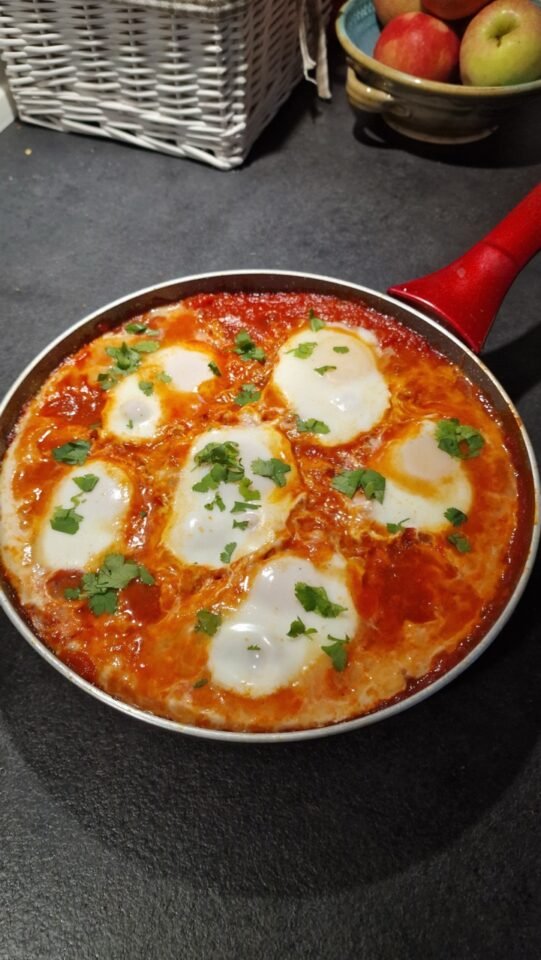
So what you see here, and what was prepared to my wife’s great satisfaction, is the most internationalized version — if such a thing can even be said. I say this especially because even among international versions, there are practically as many versions as there are recipes.
But to cut a long story short, here is the point. After tasting the shakshuka recipe presented here, my wife nodded with satisfaction and said: this is it! And since not a single drop was left on the plate, I can confidently recommend that you start with this recipe if you’re craving good shakshuka, and dazzle your taste buds, as well as your family or guests!
Shakshuka Variations
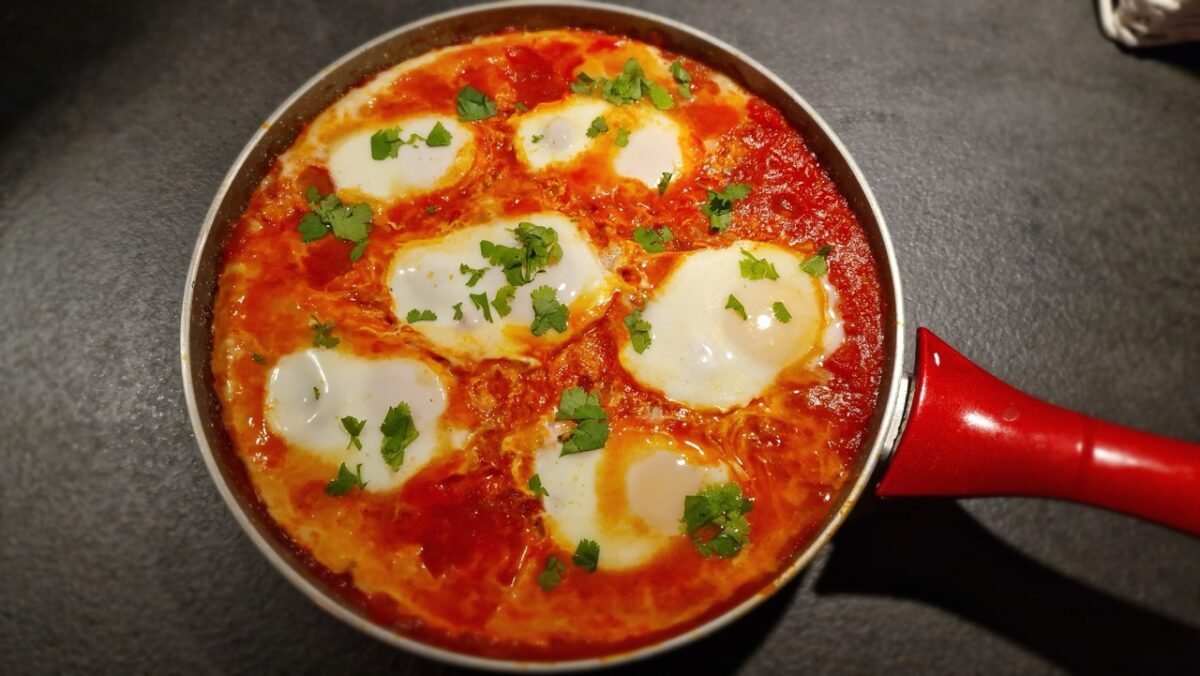
Based on the above, very different versions exist in the individual countries. Here, I’m only presenting the different versions of the internationally widespread shakshuka, because even within that, you really will find as many approaches as there are recipes.
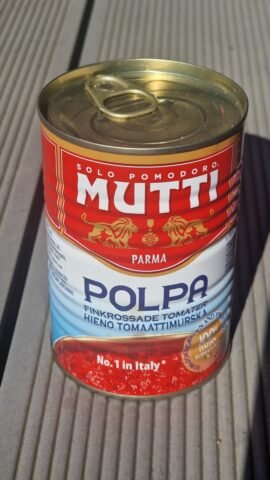
Practically the only stable point is the tomato. More precisely, a tomato sauce is prepared in some form, and that is the shakshuka. But even here, different solutions exist. While most recipes mainly use canned crushed tomatoes (polpa in Italian), fresh ripe tomatoes and tomato paste also appear often.
The poached-style eggs cracked in at the end of cooking are almost unanimously considered mandatory in international recipes, even though this cannot be said of every North African version.
Onion and garlic appear in almost every international shakshuka recipe, though there are exceptions here too. In the regional versions, however, these ingredients are not required at all.
And from here on, all kinds of possible versions appear. In many cases, red bell pepper is also part of the recipe, but it is not a required ingredient either. I added it because I think it really lifts the experience in both flavor and texture.
As for the seasoning, many people use only the classic salt-and-pepper combination. But cumin, coriander seed, paprika, chili pepper, and cayenne pepper also appear often. Naturally, the latter can partly control how spicy the shakshuka is, according to taste.
There is one more very optional element, which appears practically only in the international versions, and that is feta. Those who use this ingredient crumble the characteristically salty cheese over the top of the finished one-pan dish.
Serving Shakshuka
Shakshuka is a one-pan dish that can be eaten at almost any time of day. In the English-speaking world, since it is viewed almost exclusively as an egg dish, it is primarily part of a hearty breakfast or brunch. But it is also very good for dinner, and because it is so filling, it can essentially be served for lunch as well. In fact, in smaller portions, it could even work at a reception or party.
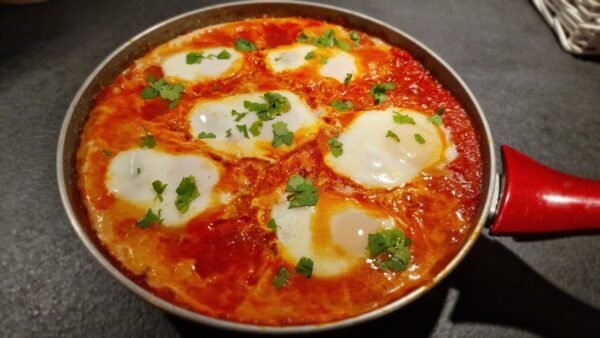
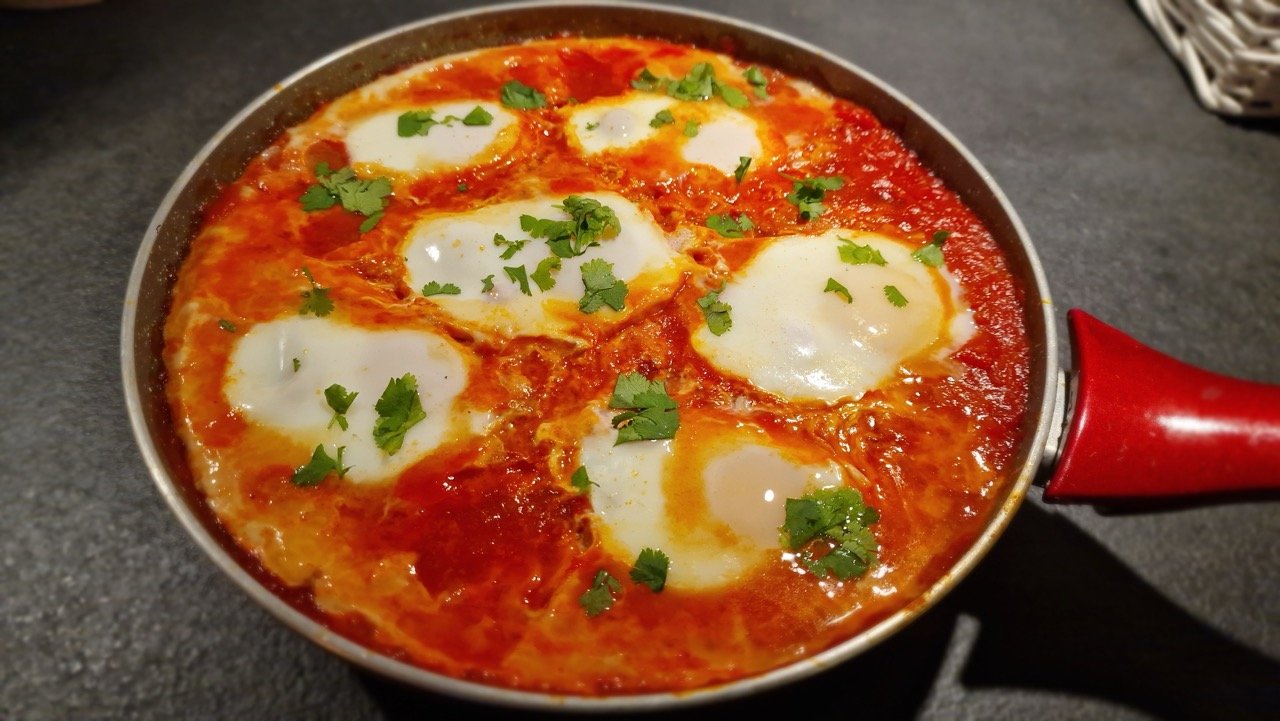
Shakshuka is made all together in one skillet; the eggs are added there too and cook as poached-style eggs right in the tomato sauce. That’s why it also looks best on the table if you serve it right in the skillet. A little chopped parsley or cilantro scattered over the top really brightens it up, but as I mentioned, feta is also often crumbled over it.
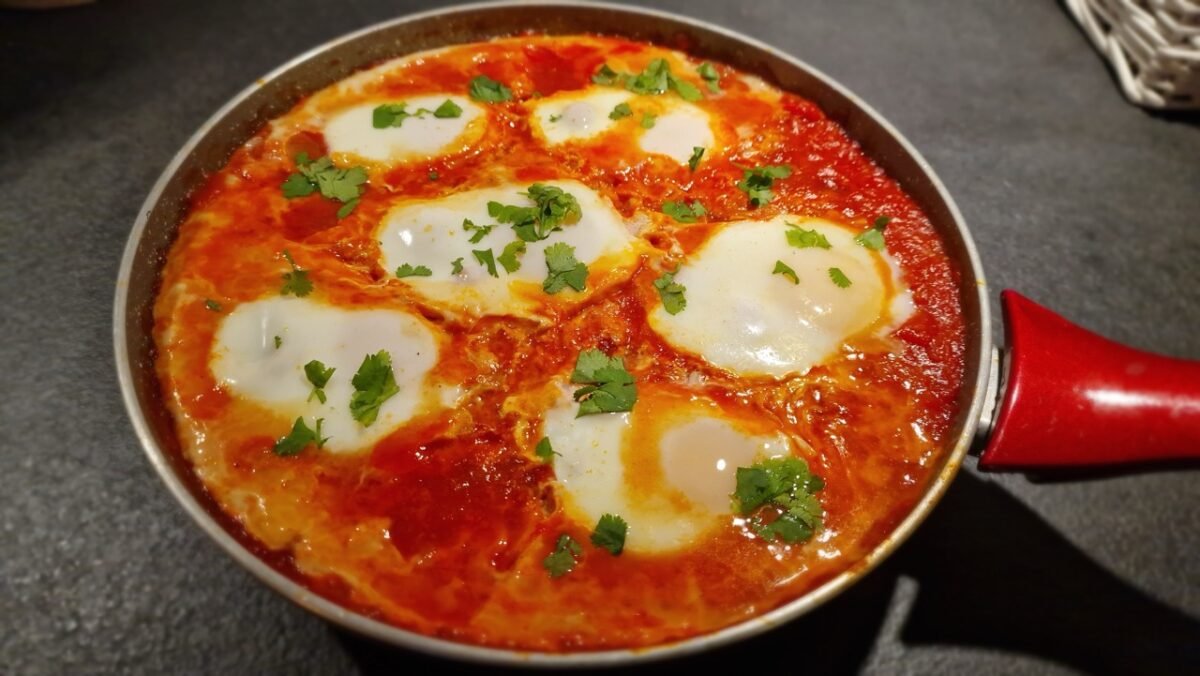
Whichever version you make, and whenever you serve shakshuka, it has one essential companion: fresh, crusty bread. Don’t forget to serve some alongside, because not only the flavorful tomato sauce, but even the egg yolk, left runny according to taste, is perfect for dipping.
A Few Thoughts About the Quantities
The size of the skillet more or less determines how many eggs the shakshuka will take. It’s also worth calculating the tomato base so that it is deep enough for the poached-style eggs. A 9 1/2-inch (24 cm) skillet is the right size for the quantities given in the recipe, so for 6 eggs.
This amount is enough for roughly 2–6 people, depending on how hungry everyone is and how you serve it.
- If the group is hungry and shakshuka is the main course, count this amount for 2 people.
- For a less hungry group, or if you’re serving something else too, it will be enough for 3–4 people.
- If you serve it only as an appetizer or at a party, you can even count one person per egg.
As for skillet sizes, you can make one and a half times the amount in roughly a 12-inch (30 cm) skillet, with 9–10 eggs, while you can make double the amount, 12 eggs, in a roughly 12 1/2–13 1/2-inch (32–34 cm) skillet. For a half batch, a 6 1/2–7-inch (16–18 cm) skillet is enough.
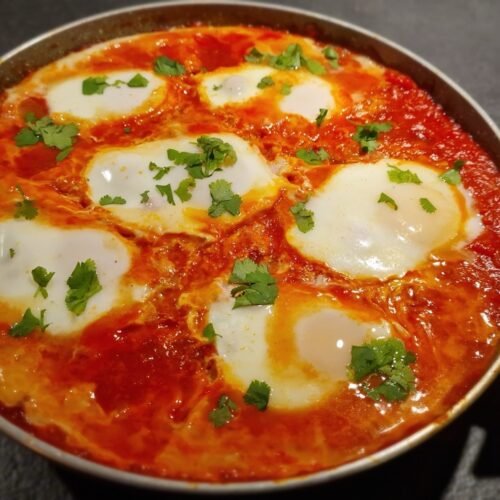
Shakshuka
Ingredients
- 1 ½ tbsp olive oil
- 1 onion
- 2 cloves garlic
- 1 red bell pepper
- 2 cans crushed tomatoes polpa, 2 x 14 oz (2 x 400 g)
- 1 tsp paprika
- 1 tsp cumin
- crushed chili to taste
- salt
- pepper
- 6 eggs
- parsley or cilantro for garnish
Instructions
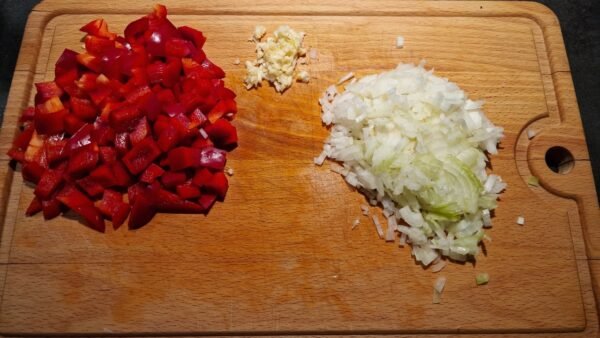
- Chop the onion and garlic, seed the bell pepper, and cut it into cubes.

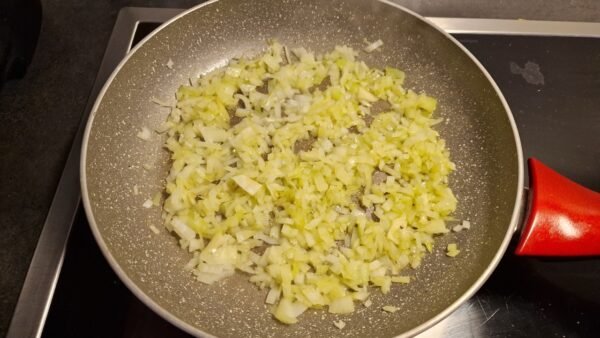
- Start cooking the onion in the oil over medium heat, stirring occasionally.
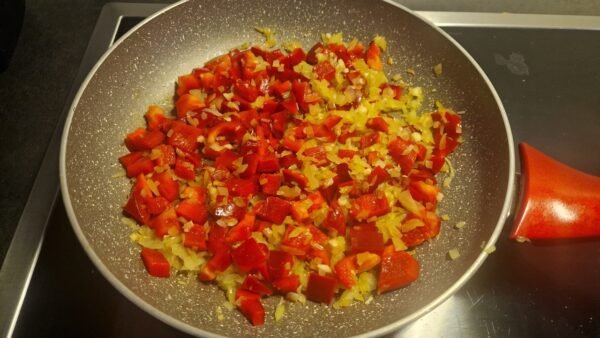
- After 3–4 minutes, add the garlic and the bell pepper. Let them soften together for 5 minutes, stirring occasionally.
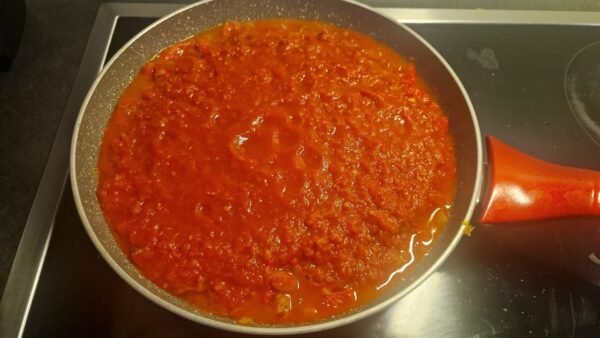
- Add the spices and stir them in. Pour in the tomatoes, stir, and reduce over low heat until thickened, about 20 minutes. At this point, check the flavor of the shakshuka, because once the eggs have gone in, you won’t be able to season it anymore.
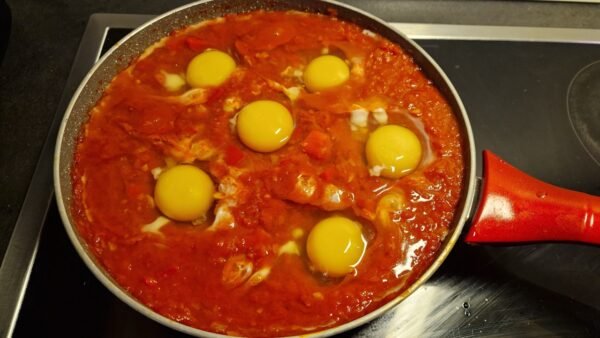
- Using a spoon or spatula, make wells in the tomatoes and crack in the eggs. It’s worth doing this one at a time, so well-egg, well-egg, and so on. Cook covered for about 7–8 minutes, until the egg whites are set. If you want fully cooked eggs, cook for another 5 minutes.
- Serve hot with chopped or torn parsley or cilantro and fresh bread.