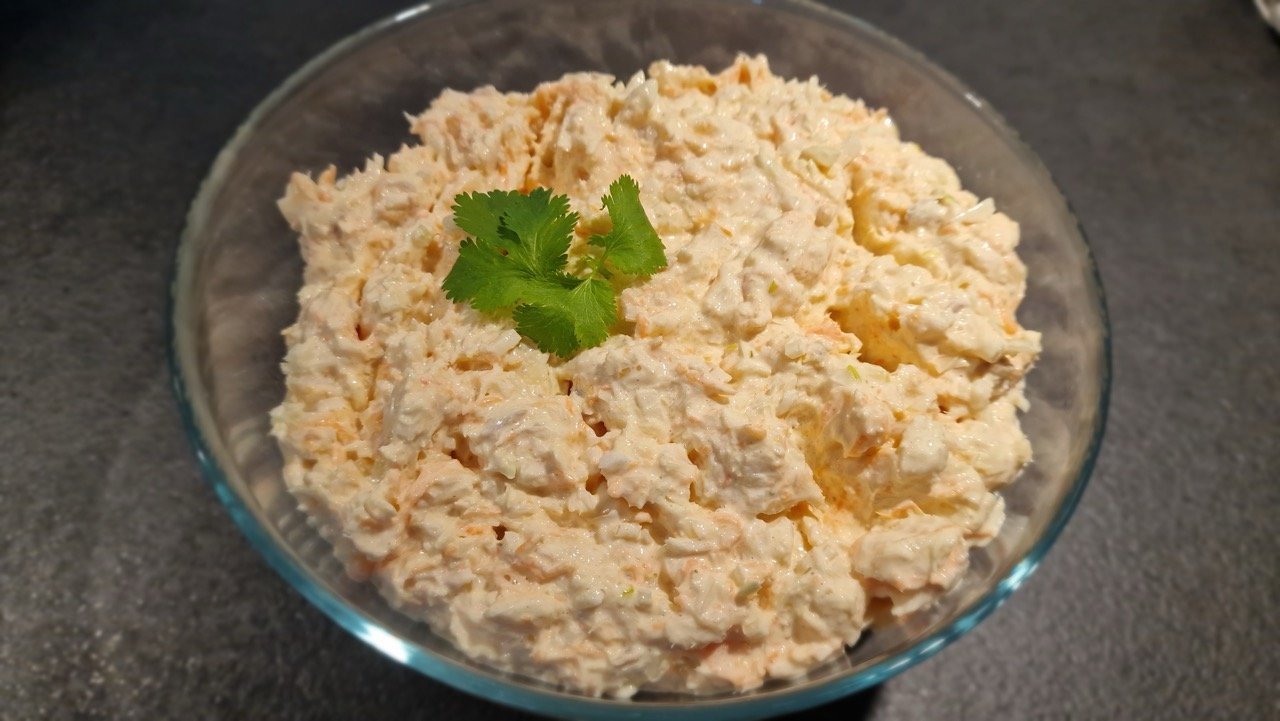
Treska could almost be called one of Slovakia’s national dishes. It’s basically a mayonnaise fish salad made with cod. You may know it or you may not, but in my opinion, once someone has tried it, it’s hard not to love it. I even know someone who otherwise doesn’t like fish, but absolutely devours treska!
It’s such a Slovak dish that, in this form, you really can’t get it anywhere else. In Slovakia, though, you’ll find it on the shelves of every supermarket in several package sizes, and larger stores even sell it by weight at the deli counter—often in several versions there, too.
A Little Personal Treska Story
A little further down, I’ll share the story of treska itself, which is interesting in its own right. But first, let me tell you how I discovered this mayonnaise-based treat and fell in love with it.
It was really my wife who introduced me to treska. In my faint memories, I had tasted it before, but the circumstances weren’t exactly right for it to leave a deep impression. My wife, though, enthusiastically told me about the good old days when they would hop over to Slovakia just to buy treska and have it for breakfast.
So once, on our way to Poland, we stopped in a Slovak town and went into the local supermarket so I could finally get to know authentic Slovak treska too.
That’s where the first pleasant surprise came. The regular refrigerated section was already full of all kinds of prepackaged versions, but at the deli counter, sold by weight, we found several more. The clerk couldn’t help us in a language we shared, but an older gentleman shopping ahead of us could, and he told us that we should definitely buy the cheapest version because that was the best. And that turned out to be such good advice that later, after trying the “luxury” version that cost many times more, we had to admit that the cheapest really was the best.
Now, I don’t want to make anything up here, but I think a kilogram of basic treska was about 2.5 euros in Slovakia back then, and it still can’t be much more than that. They practically throw it at you—basically all you have to do is show up with a little change. The fish salad disappeared right there in the car, and the memories stayed truly sweet. Well, actually sour, because treska’s basic flavor profile is strongly tangy, but you know what I mean.
Since then, there has definitely been more than one occasion when we hopped over to Slovakia just to come home with several pounds (a few kilos) of prepackaged mayonnaise fish salad. That’s “all” it took for us to like it—this is how much we like treska.
The Origin of Treska
Since we’re talking stories, let’s move on to the history of treska itself as a recipe or food creation.
The recipe for treska can be traced back very neatly to one original version—even if that version was an industrial recipe. In practice, it owes its existence to a socialist central decision. In Slovakia, or more precisely in what was then Czechoslovakia, after World War II they came up with the idea that people should eat more sea fish. Among other reasons, supposedly because cod is rich in iodine.
Anyone who did not live under socialism can hardly imagine how or why, in Czechoslovakia—a country hundreds of miles from any sea, even with the best intentions—they could make a decision that people should eat more sea fish. It’s as if some bright mind somewhere decided that instead of agricultural production on farmland, as many battery factories as possible should be built there. There isn’t much logic to it, but be glad if you live in a time and place where you don’t have to face illogical stupidity from above.
The solution was treska, or as it was called at the beginning: treska v remuláde. This is important to note because in Slovak, treska simply means cod. So today, literally, this recipe is simply called cod, but originally it was a cod salad with mayonnaise and remoulade. These days, it’s more commonly known simply as treska, or as treska v majonéze.
According to Slovak sources, the recipe was created by Július Boško in 1954. He was a cold-kitchen specialist, and as the story goes, he created this fish-and-mayonnaise salad at the request of the then head of Ryba Bratislava. Supposedly, he mixed the first batch at Hotel Carlton in Bratislava, which is a pretty nice contrast to what the whole thing later became: an everyday Slovak classic sold in plastic tubs and eaten with a roll.
And this is where treska becomes truly interesting. This is not a centuries-old traditional recipe, not a family dish guarded by grandmothers over generations, and not some delicacy that began in a romantic fishing village. It was an industrial cold-kitchen product invented with a very specific goal: it should contain sea fish, be cheap to produce, be eaten cold, and preferably people should like it too.
And, well, they did.
So much so that treska practically became a national institution in Slovakia. The classic version: one tub of treska with a fresh roll. For Slovaks, this is roughly like a good roll with a familiar cheese spread, a roll with luncheon meat, or a retro mayonnaise salad might be elsewhere: not necessarily a festive dish, but rather the kind of flavor combination that somehow burns itself into your childhood.
The Development of Treska
The original quality was later fixed by a standard as well. According to the 1958 standards, treska had to be made from cod-family fish, and the proportion of fish was about 50%. So the essence of treska is that it is a slightly tangy, mustardy, vegetable-filled cold fish salad made from cod-family fish.
Of course, in homemade versions today, there are many possibilities. Some people add pickles, for example; others don’t. Many make the original, simple carrot-and-onion version, while others also add a little rutabaga, or kvaka. As for texture, some people mix it completely smooth, but I think that is already a less good direction, because in truly good treska, the fish still has a noticeable, flaky texture. It is not fish spread, but really a mayonnaise cod salad.
Two Kinds of Authentic Treska
So if you want to make it at home, you can really choose between two directions. One is the older, simpler, more retro version: cod, mayonnaise, mustard, vinegar, carrot, onion, pepper, bay leaf. The other is the more modern, store-bought Žilina-style version, where pickles and kvaka may also appear, making the whole thing a little softer, rounder, and more sweet-tangy.
In this recipe, I follow the line that is closer to the original. In other words, I’m not showing you a modern fish spread, but that classic Slovak-style treska where the cod, mayonnaise, mustard, and vinegary-tangy flavor are the point.
The kind that, to this day, is sold in the cheapest, simplest, yet for many people most delicious version almost everywhere in Slovakia.
A Few Thoughts on the Ingredients
Treska is a very simple recipe, and its greatness really lies in its simplicity. Don’t try to complicate it. Still, there are a few tips worth keeping in mind when it comes to the ingredients.
The fish should be cod. Slovak sources repeatedly emphasize that this salad was not made from just any fish, but from relatively expensive cod. But frozen cod works perfectly well for this.
According to the original recipes, the fish is more poached than boiled in roughly 12 3/4 cups (3 liters) of a barely simmering water-and-vinegar mixture. In other words, it is cooked in water that is only just bubbling and close to the boiling point.
The cooking liquid corresponds roughly to a 1% vinegar dilution. According to what is written in the recipe, that means 12 3/4 cups (3 liters) water + 1 1/4 cups (300 ml) 10% table vinegar. I, for example, used about 11 1/2 cups (2,700 ml) water + 2 1/2 cups (600 ml) 5% vinegar. If using 20% vinegar, about 2/3 cup (150 ml) is enough. The point is that you need about 12 3/4 cups (3 liters) of a roughly 0.9–1% solution. And here, I really mean the simplest, cheapest table vinegar.
The flavor of the treska will be determined to a large extent by the mayonnaise you use. This is a “socialist” recipe, and that era was not exactly about refined taste. For that reason, for authentic flavor, I recommend the cheapest, simplest “store-bought” mayonnaise possible.
The Most Important “Secret” of Good Treska
Beyond keeping the simplicity already mentioned, truly good treska has one single secret. And that is resting it in the fridge for at least 12 hours.
One of the main elements in this salad is raw onion, and because of that—and in general, too—you have to wait for the flavors to come together. When you first mix it, it is practically even hard to taste properly. But leave it covered in the fridge overnight, or better yet for a full day, and the flavors smooth out and will speak for themselves.
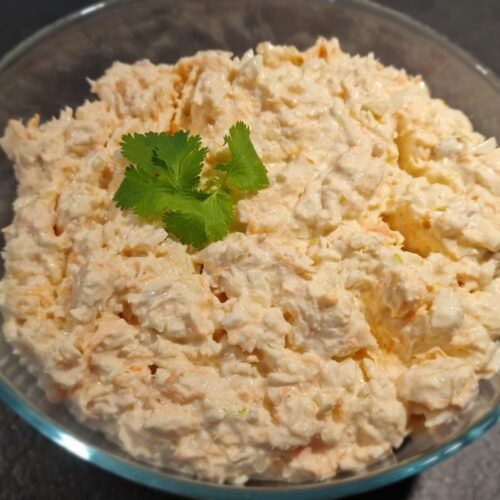
Treska
Ingredients
For the poaching liquid
- 12 ¾ cups water 3 liters
- 1 ¼ cups vinegar 300 ml, 10% table vinegar
- 5 bay leaves
- Whole black peppercorns
- Salt
For the treska salad
- 1 ¾ lb cod fillet 800 g, frozen
- 7 oz carrots 200 g, about 2 pieces
- 7 oz onion 200 g, about 1 ½ pieces
- About 1 ⅔ cups mayonnaise 400 g
- About 3 tablespoons mustard 45 g
- 1–2 tablespoons table vinegar
- Salt
Instructions
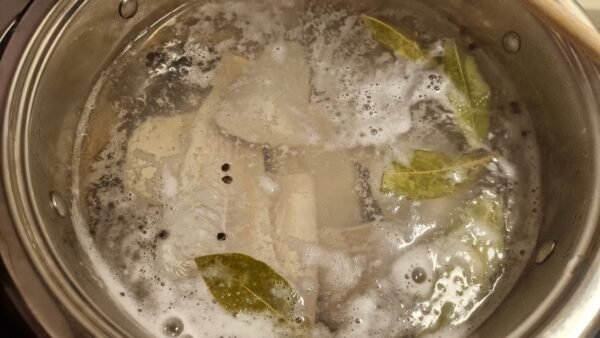
- Pour the water and vinegar for the poaching liquid into a pot, add the pepper and bay leaves, and season with salt. Bring everything to a boil, then add the thawed fish. Cook it—or rather, poach it—for about 12 minutes in water that is only just bubbling. You don’t have to wait until it comes back to a boil; the fish will be done in about 12 minutes from the moment it goes into the water.

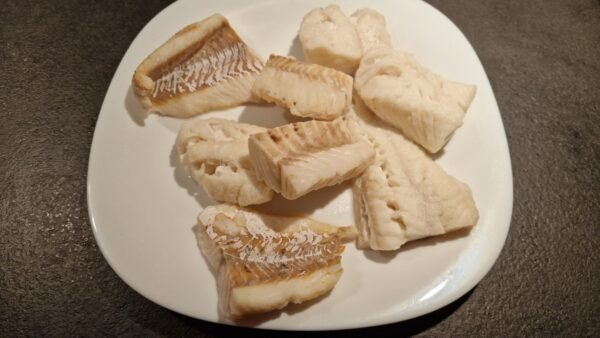
- Take the fish out onto a plate with tongs or a wooden spoon, and let it cool.
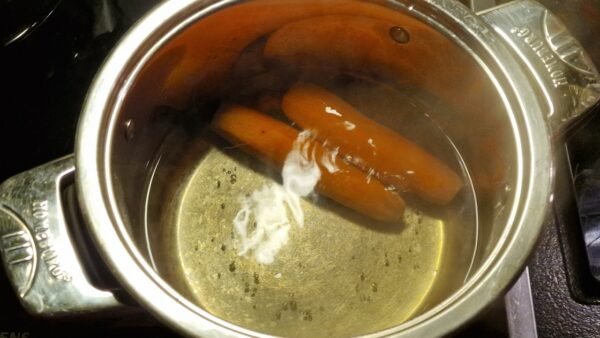
- Meanwhile, peel the carrots, and cook them in hot salted water for 4 minutes from the moment the water comes back to a boil. When they’re done, take them out and let them cool a little.
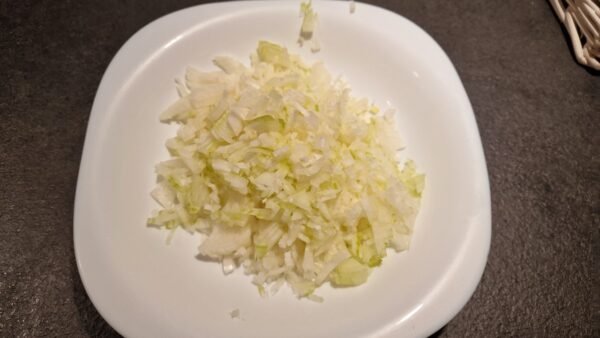
- Peel the onion and chop it very finely.
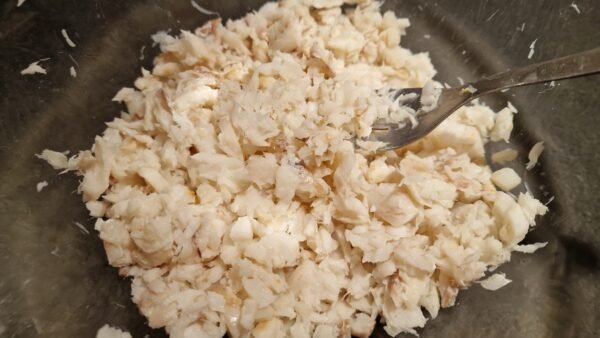
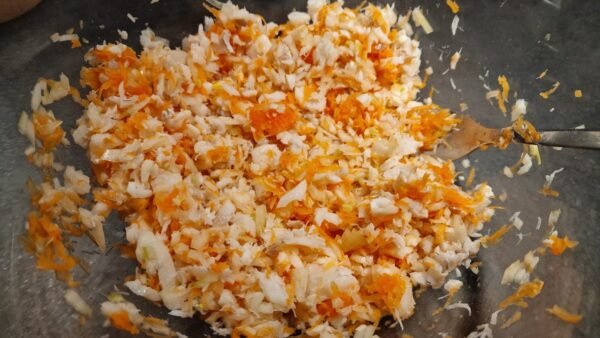
- In a larger bowl, break the fish into small pieces with a fork. One of the biggest advantages of homemade treska, apart from seasoning it yourself, is that you can break the fish into pieces as large or as small as you like. Some people like it almost “ground” in texture, while others prefer it with pieces they can really bite into.
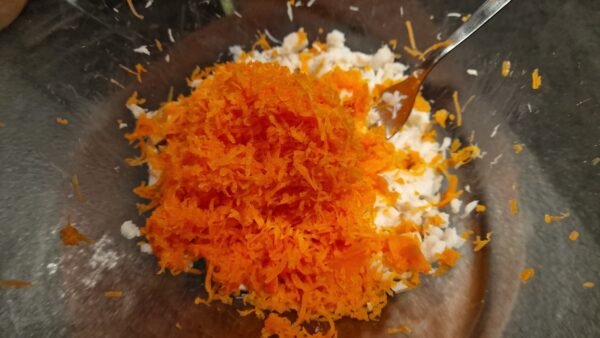
- Grate the carrot onto the fish using a regular grater. For me, this is the biggest challenge in making treska and also the hardest step.
- Add the onion, and mix everything together.
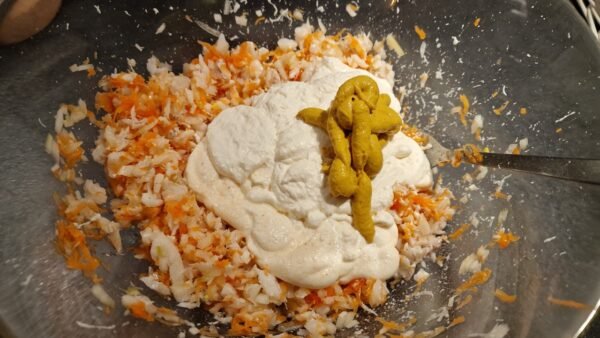
- Add the mayonnaise, mustard, and vinegar, and mix everything together. Taste it at this point, and salt it if necessary. It is important to note that, as with every mayonnaise salad, with treska too the flavors will not only mature, but also mellow. So it’s okay if the onion, or even the salt, for example, comes through a little more strongly at this point.
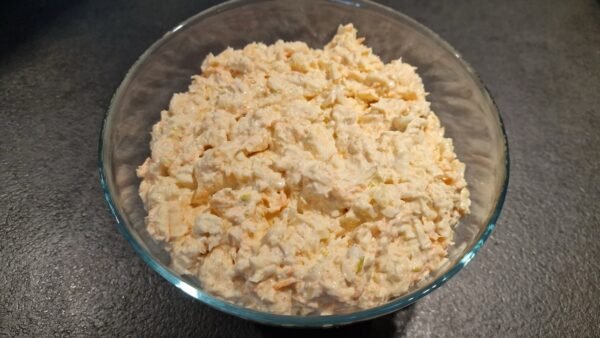
- Cover it and put it in the fridge to rest for 12–24 hours. This is a very important step—the most important one, according to the Slovak source for the recipe. Practically speaking, if you taste it at this point, you won’t get much of the refinement that treska is all about. It needs this time for the flavors to come together.
Notes
Main source for the recipe: https://www.mimibazar.sk/recept/1389/vynikajuca-domaca-treska-v-majoneze